-
Learning
In NotesLearning is not acquiring of information. Learning is an act of discovery. Perceptive observations and skeptical inquiry are what drive this act. A teacher is a person who trains a disciple to become better at observations and more thorough in his in inquiry.
A student’s discovery is distinct from his teacher’s discovery. Teacher’s own discovery is no substitute for his student’s. And a student’s discovery needs not to be less insightful than teacher’s own. The student-teacher relationship is asymmetric in time but not in value. Both benefit from each other’s discovery.
Books are not a store of information to be acquired. Books are field-diaries of people involved in act of discovery, and hence a highly useful resource for one’s own acts of discovery.
-
When asking question, also show your thinking
In NotesI just read this:
https://talhaashraf.com/showThis principle is applicable and also useful when you are asking someone a question. You can show them your thinking process that leads to the question. This gives them the relevant context for why you are asking the question, how’s that relevant for you, what parts you’ve been able to figure out and what parts you got stuck at, what you’ve got right and you haven’t, and so on.
If you don’t give your thinking to the person you’re asking a question from, you are basically delegating the task of extracting the relevant context around the question to them, which is not only too much of an ask (and hence rude), but also very inefficient and slow.
There’s exception to this principle though. You don’t need to do this when you are asking someone questions to learn more about them (instead of asking question about a specific matter or a problem). In this case, you should rather try to make your thinking less visible. Because people often subconsciously adapt their responses according to their perceptions of the inquirer’s desired response. And even if their responses are not modified and representative of their true self, they will still be restrictive to narrow specifics. When you want to learn about someone, you should rather question them in a way that allows them to be more explorative about themselves so that its beneficial for both of you.
-
Default
In PostsMost people run on defaults.
In computer or mobile, there are a lot of settings you can tinker with, so that you can get from your device what you want out of it. When you get a new device or install a new Operating System, there are settings that are already set there. Such settings are called the device’s defaults.
Just like there are device’s defaults, there are life’s defaults. Let us derive some points from the analogy.
The reason there is an option to tinker with settings, is so that the user of device can make the device fit them. However, most people do not go tinker with the settings UNTILL they encounter a problem that bugs them a lot. Only then will they look on how to fix that specific problem or ask a geeky person to fix it.
The point to notice, is that the user will have the device’s settings tinkered only for things that bugs him a lot. But there would be a dozen other options in the settings that also could have made that person’s experience with his device significantly better, but he didn’t even know about them, and hence he did not change them. [Post under editing]
——–
He didn’t know that he shouldn’t think of devices as given, he should think of them as invented, something made, something designed, by someone. The devices are a product of someone’s intention of making them. The particular way that device behaves is because someone decided to make it behave that way. If the device works that is because someone did put intention into it1.
But the point here is not merely that everything you see is a product of someone’s intention, but it is that someone else’s intention can’t make things any better for you beyond a limited extent. The ideal thing human beings can do for others is to make things with better defaults and providing a way to change them, but they can’t make things work for you, unless you put your own intention into making something work for you, and unless you make your own decision of what you want to get out of that thing.
So, default2 is the situation that exists without the intention of the person to whom that situation concerns. And when there is no intention involved of the person about any particular thing that concerns them, that particular thing usually does not fit them. In this essay I’m not worried about the defaults of the devices people use, but about the defaults of lives that people live.
Human nature is not a machine to be built after a model, and set to do exactly the work prescribed for it, but a tree, which requires to grow and develop itself on all sides, according to the tendency of the inward forces which make it a living thing.
—John Stuart Mill
The idea of having a life that fits you is very well described by Henrik Karlsson in his essay titled Everything that turned out well in my life followed the same design process, that you should read further to understand that aspect. An excerpt:
“Eventually, I looked up and noticed that my life was nothing like I imagined it would be. But it fit me.”
“When you design something, a useful definition of success is precisely that—the form fits the context—as Christopher Alexander argued in Notes on a Synthesis of Form (1964). This is true of relationships, and essays, and careers: you want to find something that fits.
- A glove is well-designed if it fits the hand nicely.
- A relationship is healthy if it fits the personalities and needs of the people involved (and the resonance between them).
- An essay is good if it fits a context made up of 1) the truth, 2) the intellectual needs of the writer, and 3) the reader’s mind. The better the form fits that context—the truer, more insight-generating, and resonant it is—the better the essay.”
And so when I say, most people run on defaults, that means they do not put intention into what they do, and hence let different aspects of their lives to develop in a way that does not fit them. And when they don’t intentionally work to develop their lives a form that fits their inner context, they are essentially trimming their their inner context by forcing it to fit whatever form is developed by defaults.
Many people run their lives on default3 and a telltale sign is that such people seem to have problems in some important aspect of their lives that are solvable (and still remain unsolved)—problems that do not involve any real tradeoff, or, opportunity cost, except, for the effort one has to put into resisting the inertia of defaults.
So, that is the problem of default. The way we solve this problem is by keep asking ourselves questions (about why we are doing things we are doing, and the things we ought to be doing, why we are doing them in the certain way we are doing them), and by deciding to do whatever we do with intention, and then using that intention to work on developing a life that fits.
https://www.henrikkarlsson.xyz/p/unfolding
- Sometimes, devices do come out even with not much intention put into them. These are what make up the crappy devices. ↩︎
- As the word default is very common for device settings (or device behavior), the closest word to that for human behavior is norms. But when people think of norms, they usually think of culture…, and religion…, and, our beliefs…, and grand and abstract things like that. Of course, these things are sources for defaults, but it is a very limited view of the defaults for humans, because there is a whole lot of things that you wouldn’t think of, when you’d think of culture or religion or social norms, etc., that too are defaults. ↩︎
- The thing about defaults is that they are not so easily noticeable because the defaults in different social-circles vary, just like the defaults of different operating systems vary. People might even look down on defaults of another circle while themselves running on defaults, just different ones. And this makes it tricky because some defaults are apparently better than others. There was a certain period in my university-time, when I used to think that the things are so better in certain private universities (as I was in a very inexpensive and unfancy public university), students there take much more interest in learning different things and doing different things, and so on. Only after observing and interacting with students and graduates of those institutions for some time, I came to realize that earlier I wasn’t looking closely, and hence missing a very important about people at these places. It was that they belonged to a place with different (and apparently better) defaults, but they too were running on defaults, and NOT doing whatever apparently interesting things they were doing, with intention.
Defaults do not necessarily mean stasis, and just because someone is not static and constantly doing something, does not mean they are not running on defaults. The defaults are like inertia of an object in motion. Or like streams with heavy flow of water. Different places have different streams (or defaults) running in different directions, with different speed. And the thing to do, is not to jump from one stream to another, or to try to swim upstream, but to get out of the stream. ↩︎
-
I don’t have time to figure this out
In NotesThere have been times when I was working on some problem and I was shrugging of a certain part of the problem saying I don’t have time to fix that and then proceeded with some workaround for that instance, and the problem re-occurred in a different instance and I did the same again, and it repeated quite a few times. And then, when I eventually figured out the mechanics of the thing, I was like it wasn’t that difficult actually, I should have learnt it earlier.
But there’s an underlying logic for this avoiding figuring-out-problem-from-first-principles behavior. The brain does this to avoid spending cognitive energy on very second problem you see, but only on problems that are recurring. However, the problem here, is that the internal tally for how frequently recurring a problem to figure it out should not be 10 or something; 2 is just a fine enough number, and if you’re really lazy, then 3.
-
The philosophy of RSS
In NotesIf you want a convenient way to get and read all new things I post on this site, you can use an RSS reader. The URL of this site’s RSS feed is:
https://weblog.tamseel.pk/rss
These days almost all sites use email newsletter as a means of staying in touch with users. But RSS works on an inverse philosophy. The site shouldn’t keep user in touch. Rather, the user should stay in touch with the site.
Email Newsletters are a push mechanism where you give every site your email address and they send in updates any time they want in your inbox. This is the push mechanism.
RSS is a pull mechanism. Here, I give you my RSS feed url. And you can add this feed to an RSS reading app and your app will fetch new items from the feed periodically, that you can read any time from that app.
The RSS approach was more popular in old times. But the shift happened as the competition for users’ limited attention started becoming fierce. In the pull mechanism, it is up to user whether to open their RSS app or not, and whether they want to get on notifications or not, and all sorts of options like that. The intention lies upon the reader.
With emails, the email lands in your inbox whether at that time your intention to read is or isn’t. For me, often times, I get a newsletter, I don’t want to read it right away, so I swipe the notification away, and I forget, and since more stuff keep coming in, the old newsletters are pushed downwards and remain unread in the inbox. So, I thought of making a new email address just for newsletter, but boy, the number of email addresses I have is already too high. I should stop workarounds and look for proper solution and the proper solution is very old and simple, i.e. RSS. That gives me full control over what I receive, how frequently I receive it, and how I am notified of it. Of course, you can unsubscribe to email newsletters as well, and tinker with your email settings, but come on, go look at your inbox. I can’t stand having that kind of inbox. At the moment, I don’t have enough actual data to tell how the experience of shifting to RSS has been, but I will write about once I have.
Now, I know, some people might not have any problem with instant updates at any time, well they can set up their RSS reader app, to check for updates more frequently and set up notifications for it.
If you want to read a better version of this posts, and a list of some rss reading apps (I haven’t tried them yet), read this:
-
Logging Movies
In UpdatesYesterday evening I set out to log all the movies I had watched since 2022. Sometime earlier this year I had added all such movies on an online service for this purpose, but it didn’t had dates, so I set out to log the dates for them as well.
Mainly, I was counting on my laptop activity data collected by ActivityWatch. I thought that maybe I had set it up a very long time ago. But it turned out, I had only set it up on 9 Oct 2024. So, for movies I had watched after that date, I was able to find out the watch dates from there (after a lot of trouble trying to get python running in wsl to connect with ActivityWatch running on main windows. What worked was to quit ActivityWatch and open it again at 0.0.0.0 so that WSL could also reach it). Then, for movies watched before that, my second source was my google browsing history exported from Google Takeout to an excel file. Now, I usually downloaded videos through Brave browser (meaning nothing in google history), but still it worked out for many movies, because in many cases, I used to google something about the video either before or after watching it, specially wikipedia page or related history if any (and sometime explainers) on my main chrome browser. Sadly, however, I had created that export in Apr 2025 and had found it having only data for past 12 months. So the last entry in my excel file is from 8 Apr, 2024. So, for movies watched before that, I had no data. But, I recalled another source. Now, I used to download movies and delete them after watching (because my laptop didn’t had much storage) but for movies that were good enough that I thought I would watch them again some time, I did not delete them. But in somewhere around june this year, I had bought an hdd with case to keep backup of my laptop data and also to offload unnecessary data from laptop. On that, I had also moved those movies. I was worried that when moving the files there, the file created date would have been changed to the date, I had moved it to the hdd because I had copied it through normal windows gui and not through commands that preserve original properties. But I thought to give it a chance, and I connected the hdd. Interestingly, the date created property had modified as I had thought, but the date modified property still showed the same date on which the file was created originally, or you can say the download date. I was able to verify it for the movies I had logged already. So, I got a bunch of more movies from there. I did that till yesternight.
It’s morning now, and just gotten on my laptop, and 37 out of 106 are still remaining to be logged, that are mostly those that I watched before Apr 2024. Now, a few might be actually after Apr, so I might be able to find data for them. As for the rest, I’ll have to extrapolate the dates, by thinking of the conditions and the place where I watched them and the time in which I was in that place. For instance, I remember a movie someone had recommended me when a certain event was happening at out university department. And I can find out the dates for that event, and from there I can get a close estimate of the dates. The idea is you can always get hard bounds for possibility of a certain event to occur, and then you further narrow the bounds as much as you can to get closer to the actual date. Well, let’s see what happens. I’ll add progress here.
So here’s the update. I was able to figure out a few more from the excel and then finally 30 were still remaining. So, I recalled that when I had created Google Takeout export, the history was not actually set to auto delete. So, I checked it again. And lo, the google search history before Apr 2024 still exists. Finding it out made me so happy. But irritating thing is I can’t export. Google Takeout only exports data of last 12 months, though technically it should export all data. So, after very tedious searching I was able to find dates for most of them. Around 10 were those for which I had to conjecture the date based on hard bounds and around which movies I had seen them. But I have a pretty close log now. Last year, I had done a similar dig to log dates of books read (though I had to use different methodology like linking books with reference and place bought and the place read and cues like that to find out the date I had read it).
Well, the final takeaway is that this movie era needs to end soon.
-
I’ve been fooled
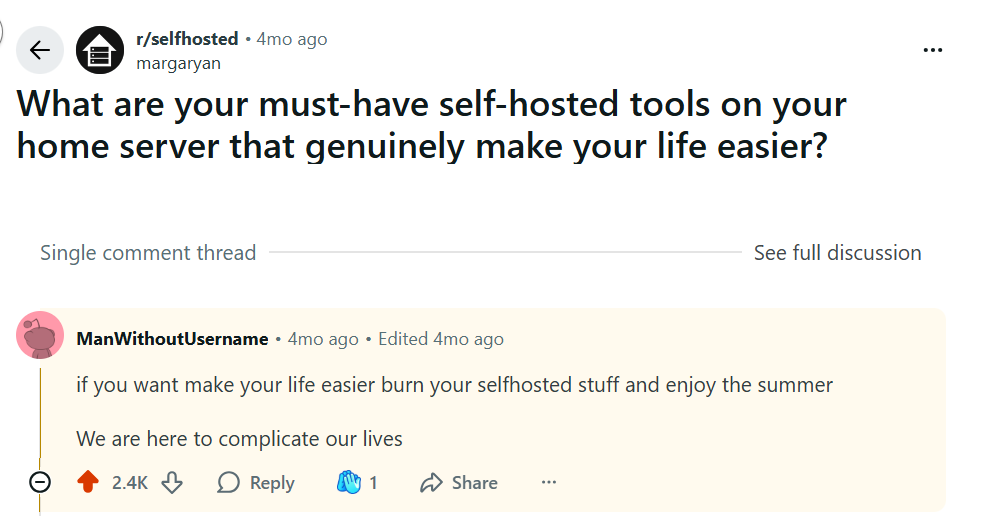
In UpdatesMy websites are being served from a server in Mumbai, India. But when a user in Pakistan requests a web-resource hosted in India, traffic is first routed to Singapore and then to India (and same path backwards) despite that there are submarine cables directly connecting Mumbai and Karachi. Apparently, there’s an undefined security policy restricting Pakistani ASNs to directly connect to Indian ASNs.
So, had I deployed my server in Singapore instead of Mumbai, it would load (slightly) faster even though Mumbai is geographically closer because it wouldn’t have to cover the extra journey to Mumbai. But the actual fooling thing is that the server location with lowest latency from Pakistan is actually Dubai, and it probably would have been even if we had direct submarine connection with Mumbai (though things would be different if the terrestrial connection with India across Lahore is established).
I guess I’ll have to set up a server in Dubai now1 😭
Quoting this legendary reply:
- Also, I heard Caddy is even faster than NGINX. Maybe, I should experiment with that. ↩︎
-
Paraphrasing learned wisdom as your own tends to be more impressionable than referencing it
In NotesI have seen it happen many times, and I myself have even been on the receiving end. A possible reason is that when a person is confused and you tell them, hey, X has said something good about just this kind of problem is kinda redundant and useless. If you have internalized learned wisdom well, you probably would be very well able to speak it out directly (because you had actually applied it and seen it work, (or if something not experimentable, you’d have followed a thought experiment and reached the same conclusion independently)).
This is useful to know when you’re helping other people solve their problems, because I have this instinct to point people to original source where I read/heard the concept, and it is useful in some cases, but in most cases it isn’t. Or I should say, pointing to original source is useful at the end of conversation or after the idea has made sense to the other person not before it.
-
Interesting?
In NotesI unblocked x today to export my tweets (so that I can import them here), but I wasted next half my hour scrolling through it. Earlier, when I had blocked it I had written something like “it is ironic because the content on my x feed is actually interesting”. But now, I feel like, even though the content might be interesting in itself, but for me specifically, it unarguably was having an adverse effect at least the way I was consuming it.
I have been using the word “interesting” as a catch-all for all things good or things that I think are worth pursuing further. But, it isn’t a good idea to keep pursuing things which are interesting in themselves, but have a net negative effect on you.
-
Move
In UpdatesI keep forgetting again and again, that when my mind is not working as well as it could, more often than not, it is not because my mind is lazy and not exercising well, it’s because my body is lazy and not exercising well.