-
Interesting people are kid & adult at the same time
In NotesI was down the Aaron Swartz rabbit-hole once again, and it made me notice how some of the interesting people are essentially the same kind in both childhood and adulthood.
In childhood, they do serious things and work with passion and think about things as if they were adults, and in adulthood too seem to be unconcerned by things most adults take too much seriously.
In other words, although their experience and worldview changes as they grow older, but an essential attitude of theirs remain the same. There’s some lightness in children that doesn’t necessarily need to go away as you become an adult. On the other hand children too can do serious work and think about important things. It’s not an adult chore to do but a very essential human experience that doesn’t need to be delayed unnecessarily.
This isn’t how most people think.
-
On human behavior and beliefs
In PostsThere’s a pattern that I have noticed so many times, that if someone asks me what’s the most fundamental thing I have figured out myself, I would tell this.
Most of human behavior is stuck in re-enforcement cycle. People model human behavior based on their observation and then build systems based on those models, and those systems end up influencing how humans behave, without the initial observers realizing that the behavior they observed initially was itself influenced by the previous systems (or environment) those people were living in. A lot of man-made systems work not because they were based upon models of human behavior that were fundamentally true, rather because these systems can shape human behavior to fit accordingly. These systems are self-fulfilling prophecies. In other words, if people have a collective belief about human behavior, that belief will become true, because everyone would behave as if it was true, in result prompting people to behave that way even if they originally wouldn’t.
I first noticed this phenomenon while studying economics where it was assumed that work is a “bad” — something that people dislike in itself but do so because it earns them something (income in this case) that they like by a greater degree. This assumption was irritating for me because the kind of people I admired were all those who loved their work, and so I objected on this assumption. I was told that there are certainly exceptions but this is what explains the behavior of most people. They were right about that, but what they got wrong was that they built whole economic theories on this assumption without ever questioning whether work is fundamentally a “bad” or whether most people do a primary work that they dislike because it’s the system-default and they never put much thoughts or efforts into finding an alternative 1. This belief probably wouldn’t have caused any problem if only a few individuals believed it, but when everybody believes that work is a necessary evil for earning bread, you see rise of what David Graeber calls bullshit jobs — meaningless jobs that only support other meaningless jobs where people are doing useless busywork thinking they are doing real work.
But it was soon enough that I started noticing this pattern at other places. Money is just whatever people believe will be accepted as a medium of exchange. In financial markets, an asset will become “valuable” if a lot of people believe it is valuable. If people expect inflation to happen, it will happen.
Beyond economics, consider how we raise our children. Most people believe children are dumb. Even if people don’t say it out loud, they treat them this way, including their own parents 2. Schools are designed on the same premise that children are stupid and very slow-progressing. Unsurprisingly, a lot of children do end up being stupid and slow-progressing, because that’s how schools handle them. Now, I am presenting this phenomenon it in the right order, otherwise someone’s first observation would be that children are stupid and slow-progressing, and then will see schools designed on the same premise and will be satisfied that schools are well-designed for society’s needs 3.
A rather unexpected case of this phenomenon was something I realized relatively recently while watching an Adam Curtis documentary. The reason sexuality more influentially shapes people’s lives in US than in countries like Pakistan is because Edward Bernays — nephew of Sigmund Freud — had employed Freud’s sexuality-centered psychology theories in shaping public perception in US on a massive level during his work for big corporations and the government. Freud is a leading figure in psychology probably not because his theories were fundamentally true but because some people in power believed they were true and built systems based on his theories that influenced human behavior, thus turning them true as a consequence.
Coming back to the main idea of how these systems and beliefs are self-fulfilling prophecies. I was talking about this phenomenon in the parenting context with someone when this idea connected with another thought that I was thinking independently but was related to the same idea.
This self-fulfilling pattern not only applies to beliefs of groups of people in authority 4, but also to beliefs one individually holds.
A lot of beliefs are such that they would be true if you believe them to be true and would be false if you believe them to be false. A simple example is that if you think a university degree is important for good livelihood, university degree will most likely end up being important for your livelihood because you won’t spend time doing things that could improve your livelihood more than your university degree. Same case applies if you replace university degree with skills, connections, or your zodiac sign.
Another example is one’s perception of being blessed or miserable. If someone thinks their life is miserable, it is miserable regardless of how good it is by objective measures, because one’s standards of living don’t matter if one doesn’t feel content with their life. Blessedness is only real if perceived.
Similarly, people who think that they could become exponentially better in something if they put in the required time and effort, are the only ones who actually end being seriously good in that thing 5 because others never risk investing that much time and effort 6.
Now, the apparent conclusion from noticing this pattern might be that perception and beliefs are all that matter, and we should thus shift all our focus on shaping these beliefs.
But this is incomplete thinking. Focusing on just beliefs works only if there is no fundamental truth about reality. And if there is no fundamental truth about reality, why do financial bubbles burst, and markets take correction? Why do societies fall after their glorious rise? Why do homeschooled kids outperform schooled kids? Why do some people get to spend most of their lives doing what they love while others spend most of their lives doing what they hate? Why do people who believe true understanding of things is better than hacking for exams end up feeling better about what they do in lives and vice versa for those who think otherwise?
The simple answer is that there exists a fundamental truth, but it will benefit you only if you believe it to be true. On the other hand, if you believe what’s not fundamentally true, you might still feel that your beliefs are true without ever realizing you could have done so better if only you believed in what was fundamentally true.
- It might be that at a certain point in history that for most people, there were no alternatives to working in agriculture or similar occupations even if they disliked it because technology wasn’t advanced enough and reaching production levels necessary for survival needed putting in a lot more amount of work in certain areas regardless of whether people liked them or not. But with technological progress, this certainly ceased to be the case, but the default systems persisted and people continued to believe that working on things they don’t find interesting is necessary for survival. ↩︎
- I theorize that the reason kids continue doing baby-ish activities these days is because parents like the baby version of their children and thus do not train their kids to act mature and take responsibility for things — but this is probably a discussion for another essay. ↩︎
- Fourteen-year old Aaron Swartz had figured out the absurdity of how children were treated and you could feel his resentment in his essay explaining it. ↩︎
- For most part of history, these group of people were those who held power, because they directed the flow of information. But with tools of mass spread of information, this can now be individuals with otherwise no power who somehow happen to gain mimetic virality. ↩︎
- Visa’s examples of serious people are also an example of this. ↩︎
- An exception for this is when individuals are so absorbed in that thing that they don’t even bother thinking about how good they can be at it or the consequences of them failing to be good at it. They simply don’t care about the secondary things at all. ↩︎
-
Thoughts on Parenting
In PostsThe following is an archive entry from a chat with TA where he had asked me how I had learned English as he had done it by consuming media in English. I mentioned the same along with mentioning how my mother sometimes used to make us write about random things such as some character from the cartoons we were watching and so on. He later mentioned how internet-era kids are so better at English comprehension, on which I objected on the ground, although their English is better, overall today’s content is mostly slop and it has made kids dumber. I then explained that by slop means how the context for the videos or the kind of content kids watch is fake. Kids continue watching baby stuff and that’s also because parents want to continue thinking their kids as babies. During the chat, he had shared a sample video for what his nephew watched when he was <1 years old which was this.
The next day, I replied to the message with the link to this video and wrote the following which makes this blog entry.
I just watched it now.
I am not well-informed about the topic to form any opinion for now about if it’s good, neutral or bad for babies to watch this.
But in a broader context, my point is this:
These kinds of videos that are made around educational context (language in this case) get wrong about learning just as what Duolingo gets wrong. It’s kind of like baby version of Duolingo.
Duolingo’s philosophy is that social media use different tactics to addict people to consume slop there, but we could use the same tactics to addict people to learn things. There hasn’t been any consensus, but I think there’s a lot of people who disagree with this philosophy including me. It’s same as how some ideological groups claim to “liberate” people’s thinking, but what they do is to get people out of one dogma, but put them in another dogma. True liberation is to make people think for themselves. Similarly, true education would make people safe from unhealthy habits and addictions, not use same techniques to make them “learn” things.
In the video, you could see that words were matching with the visuals which is good, but what is bad is that babies also understand what’s happening, and what’s happening is that a bus is going somewhere and people in bus are doing weird actions while singing a rhyme. The situation was based on reality, but with an artificial/fake context.
This should not make you think I am against purely imagined worlds. Doraemon is something I have watched a lot, like too much in my childhood. A lot of things were imaginary, but there was some real context around it. Cat robots don’t exist in real, but friends do help each other. What I mean by context is the story — what is actually happening. And this is what babies and kids naturally pay attention and what they should pay attention to. While, the learning would happen automatically. For this reason, I think Doraemon is an excellent cartoon for kids, because the un-intentional learning in it is way huge.
Now, this was a bit tangent because Doraemon isn’t for babies, and you’d agree that Doraemon is suitable for kids older than babies. But check out this cartoon that I used to watch when I was a kid (not a baby, or I wouldn’t remember 😂) : https://www.youtube.com/playlist?list=PLJuI8TslmruBKI-b0R3InlY7gW17b-U_J
Now this world is purely imaginary, but the context is real.
Also, if you watch this cartoon, you will realize how slow it is, which I think is very important thing. The main issue with YouTube kids video is that kids won’t want to stop watching these videos, because they get kind of addicted to them, which is because how fast-paced overly-colorful these videos are which hyper-activates kids’ brain in a wrong way. I don’t remember exactly where, but it was maybe a DW Documentary where they showed that experiments were done with rats who were shown constantly blinking colorful lights on a monitor, and they noticed observable anxiety or hyper-activity in these rats. This thing might not be as harmful for adults, but for children’s brains, this is very bad.
But apart from that, I also don’t buy the assumption that kids can’t understand adult stuff. Maybe try showing space videos to your nephew and he might not get as bored (getting bored is also a good thing btw, that is when all creativity happens), or he might not dislike them. Now, I don’t mean to suggest an extreme view of this (any extreme is bad), but the reason I’m insisting on this is because there in a complete consensus on the opposite extreme that kids are dumb by default and thus, they should only do childish stuff.
This is a point that Aaron Swartz hated when he was kid. He used to do interesting real stuff from very young age and hated it when his environment assumed that kids are dumb by default (See this essay he wrote when he was 14: https://web.archive.org/web/20020819014933/http://www.aaronsw.com/school/2001/01/21/ . He had similar thoughts when he was even younger). Henrik Karlsson makes same point in his Apprenticeship Online essay. Actually, this is also what my mother used to believe and thus she did not treated us like kids the way people usually do.
People would look at kids and babies, and notice the childish stuff and how dumb they are and think that children are supposed to be like this, but they fail to notice that precisely because they think this, they themselves create such an environment which actually makes them childish and dumb.
Tangent thought, but this is a pattern I have noticed so many times, that if someone what’s the most fundamental truth I have figured out in life that other people don’t get, it’s this. Most of human behavior is stuck in re-inforcement cycle. We see people, we notice they act in a certain way, and create models and systems according to that way, without realizing that people act that way because the previous systems or environments encouraged that kind of behavior. These systems are self-fulfilling prophecies. If on mass level, people have an assumption about human behavior, that assumption will become true, because everyone would be behave as if it was true, actually prompting people to become that way even if they originally wouldn’t.
-
Solitude
In NotesIt turns out different people mean different things by solitude. So let me put different words for the different ideas.
Firstly, there’s the idea where someone is both physically and virtually disconnected from other people, such as when people abandon their phones etc. and go to a far away isolated place. This sort of solitude tries to minimize social interaction with other people. We can call it external solitude.
In contrast to this, is the idea of internal solitude. In this type, one might be living among people in a seemingly usual way. He might be living in a hostel sharing room with his roommate, taking a bus, buying grocery, etc. So apparently, he is doing social interactions, however, none of these social interactions actually take space in his mind, because his mind is mostly occupied with his own ideas.
The more I am writing, the more it’s becoming apparent that these classification are not true classifications but rather loose attributes with blurry distinctions, but nonetheless, I’ll continue these thoughts and would later reprocess them to see if they make sense.
Then there’s this another distinction based on the perspective of the person in solitude. One is thought solitude where one tries to block out input of information or thoughts from external sources (save one when one is reading?) so that he can spend his time thinking about and refining the thoughts or ideas already accumulated in his mind.
While, the other form of this is poetic solitude where the person derives a poetic pleasure in spending his time in contemplation of beauty of the things around him. But it’s not just about contemplation, I think, it’s also about becoming more receptive of your surroundings, in order to see what is hidden in plain sight. And so, it does not necessarily have anything to do with writing poetry, but those who actually wrote good poetry did so by this means.
Both these forms are interesting, but important to note these are two distinct things. There’s also another offshoot which is loosely attached to this classification which is the meditative form of solitude. I don’t know much about it, but from what I have heard or read, it involves removing each and everything from your mind, whether ideas, thoughts or whatever. So, you are neither contemplating your surroundings, nor your own thoughts, nor others’ thoughts, but just trying to empty your mind, sort of like an F5 for your brain.
I guess these are all forms that come to my mind now. These forms although distinct are not permanent. There was a time when I used to spend some part of my day in poetic solitude and some part of my day in thought solitude, specially in my early university days, since I had come to a somewhat new social environment, I was being more perceptive of the new surrounding (and I also was being some sort of poetic about it), but after 2 years, the poetic part almost faded away, which sometimes feel strange to me because it was nice too, but these are the things for which there’s no point forcing yourself into.
Similarly, some people might spend most time in internal solitude, but sometimes they need external solitude as well to amplify the effect of internal solitude.
-
WhatsWrapped!
In UpdatesSince it’s the last semester going on and our degree is about to end, the idea that MUA had shared first 2 years ago, which I had later become disinterested in, resurfaced in my curiosity.
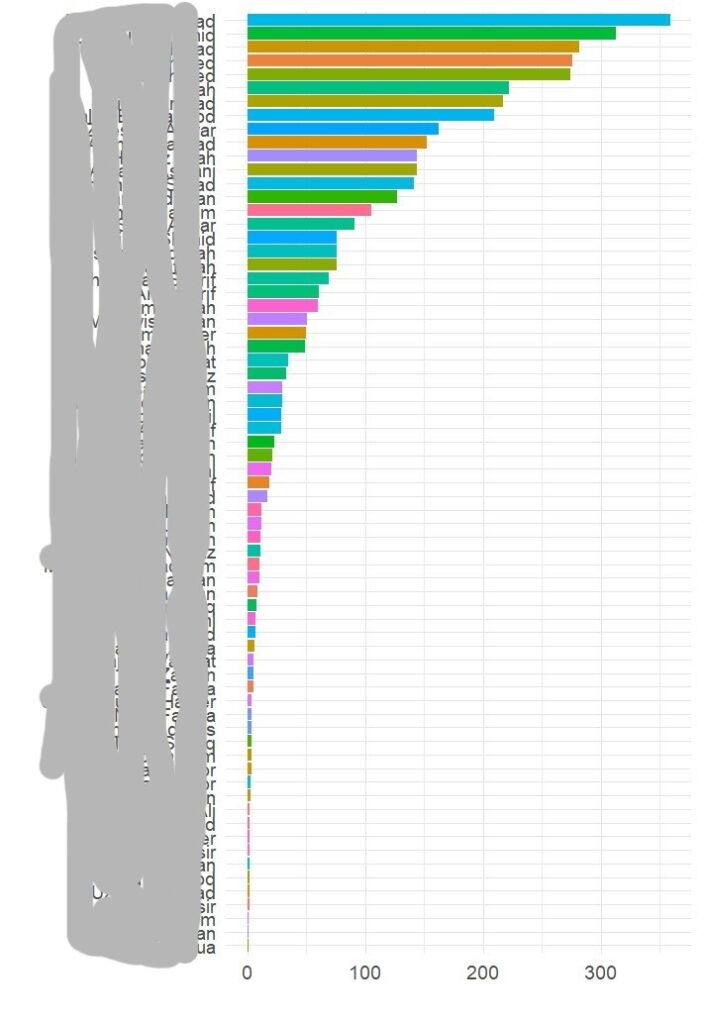
So I did that—analysis of WhatsApp group chat of our class. Here’s the gist of around 4200 messages sent in span of 15 months.
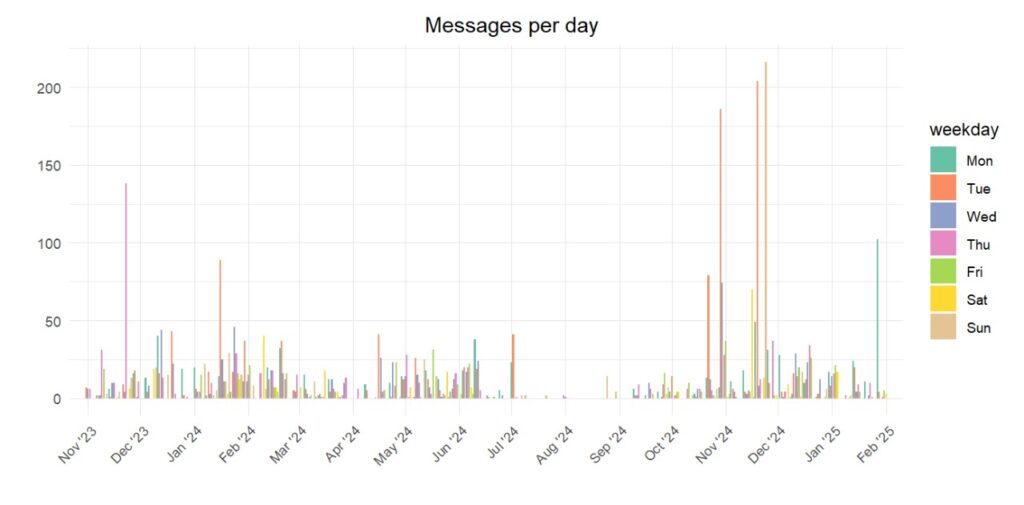
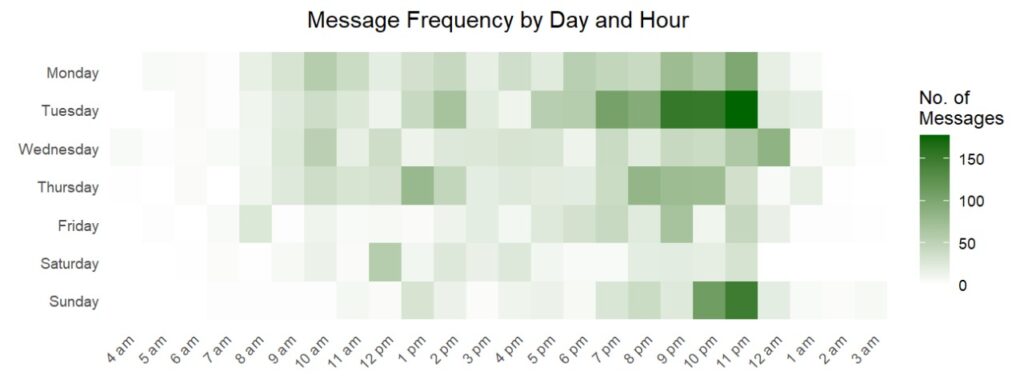
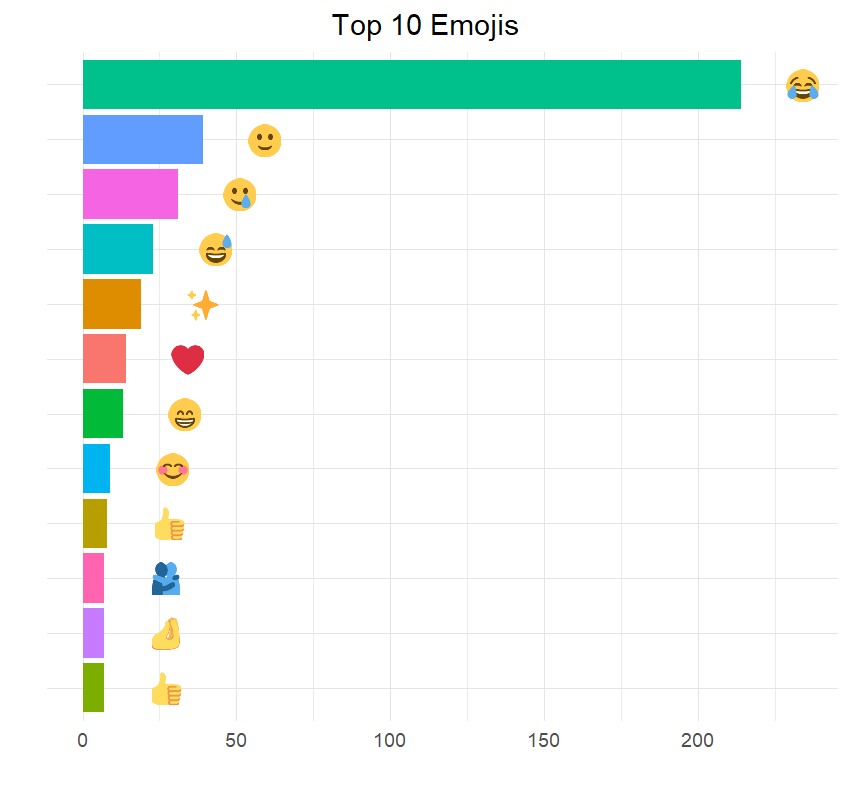
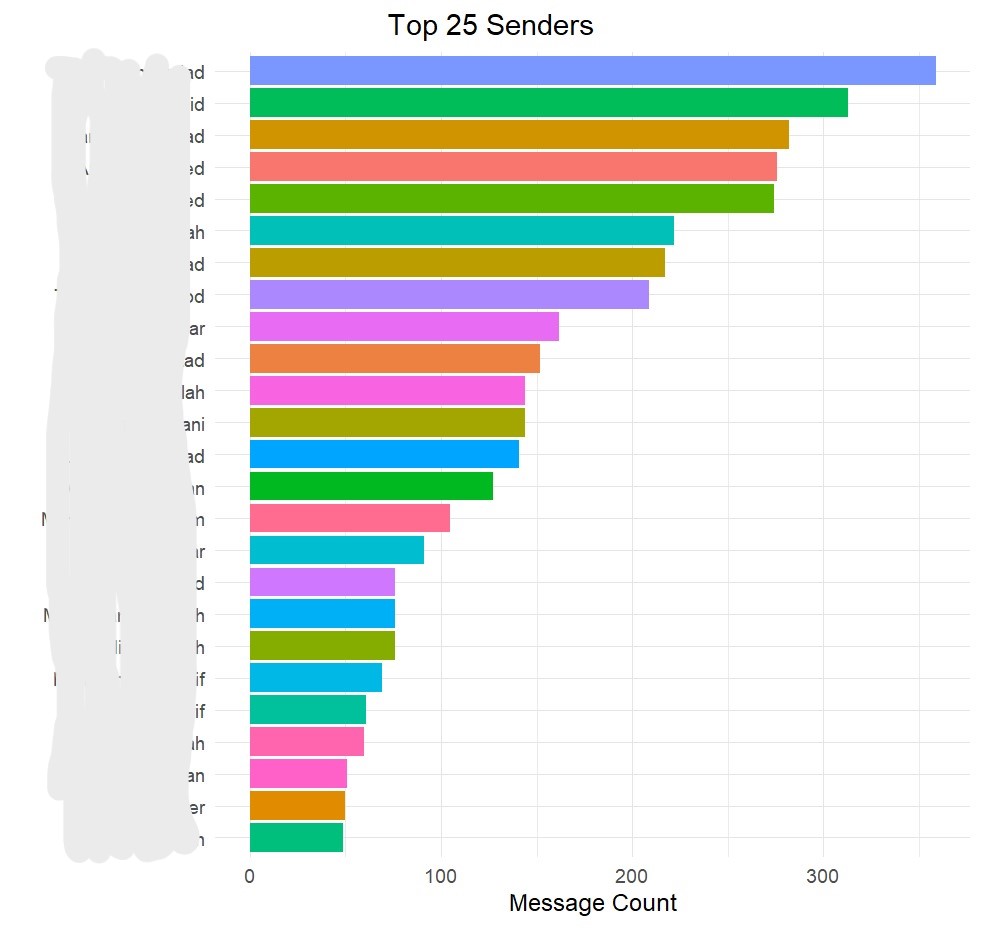

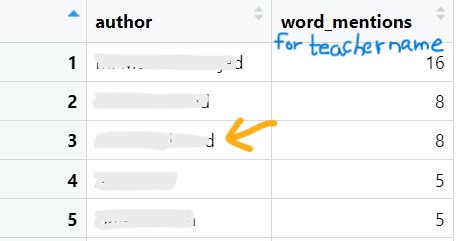
Note: Words message and edited were WhatsApp generated and thus do not count as valid. The 6th most used word (at 8th no.) was a teacher’s name.
These were the charts I sent in the group and asked my fellows if they were curious to know about something else.
One was about message count of others apart from the top 25. This shows us the total distribution.
Another was about who most used the most used words, specifically the most used word class and the teacher name at 8th no.

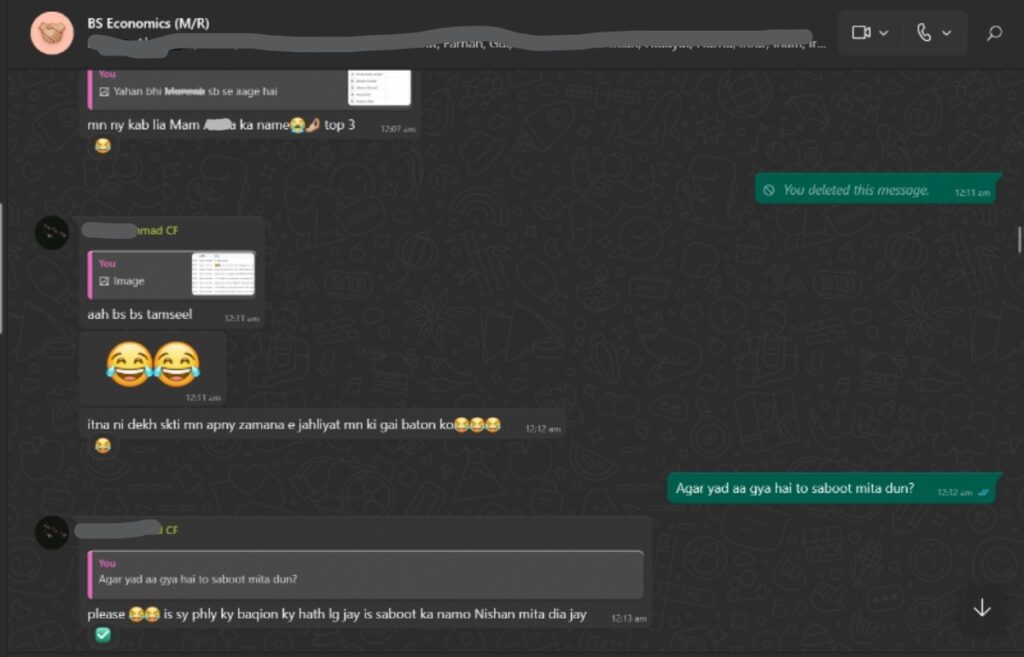
The funny part was when the class-fellow who was the 3rd (/2nd) person with highest mentions of that teacher asked when she had taken that teacher’s name. So, I filtered the dataframe with her as sender and text containing that teacher’s name, and sent the results. The results included that instance when she was ranking (satirically) various teachers and some other students were provoking her. The texts are very hilarious but can’t be shared here since they contain TMI.
.
The most tedious part in the whole exercise was mapping the missing phone numbers (those not in contacts) to the names of students by searching for any instance when a text containing the roll number or other identifiable information was shared from that number.
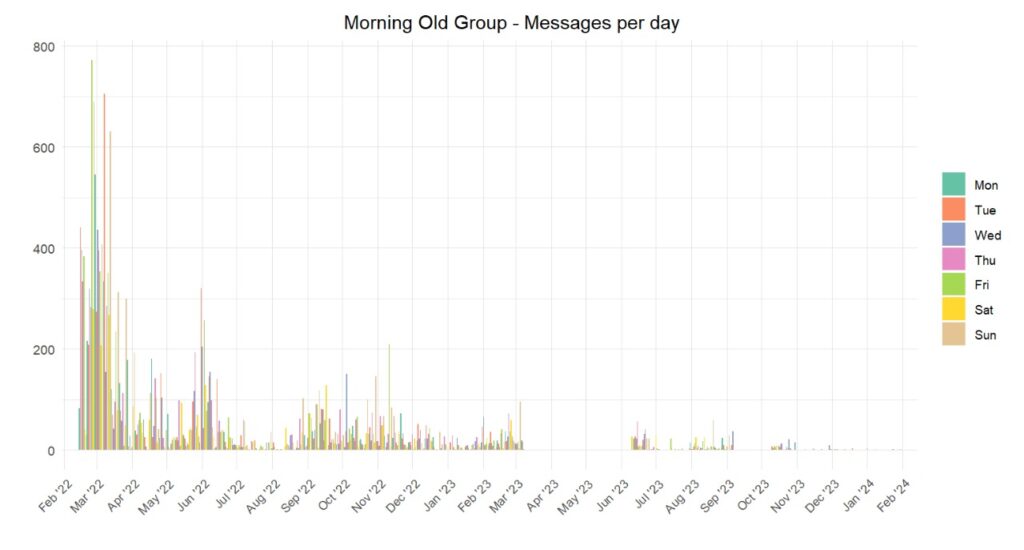
Anyways, this was the overview of the group which was formed around 4th semester when morning and replica classes were merged. In the earlier group of morning class, messages were sent in an amount incomprehensible for me. Explains why I had joined that group several months later.
The part that hit the most was when I thought of converting my R script for analysing whatsapp chat export into an R package, and found that someone had already built that 😭. Had I known that before, I wouldn’t have needed to write that script. (Actually, I am not sure. I probably wouldn’t have found this interesting if I wasn’t writing the code. Maybe I would have. Who knows?)
-
Internet Companions
In PostsI have been meaning to write on this for so much time.
Unrelatedly, I have been meaning to delete my Linkedin account for so much time.
So, it is today that I decided to do both.
For me, who started playing with computers at the age of 4, computers have always been fascinating machines, but my experience of interacting with people on internet is relatively new. I do feel nostalgia for the time when we used Yahoo and Gmail messenger to talk with our relatives far away, but I was a kid at that time, and it’s just nostalgia. My later use of internet consisted mostly of playing flash games on Miniclip, Friv, etc., and learning about random tech stuff to fix things for other people like, how to install Windows, how to wipe an iPhone with forgotten password, how to install a paid mobile game for free, how to install phonetic Urdu keyboard and format Urdu documents in Word, how to make printers work, how to flash a stock ROM on android device, etc.
My first interaction with people on the internet happened in 2020.
I was in grade 11, and I don’t remember how, but somehow on the internet, I learned about a place where they were providing free online courses related to tech skills. It was called DigiSkills. At that time, just the term GraPHic deSigN fascinated me so much that I enrolled in that course. A few months after, I realized graphic design is not my thing. By that time, I had accidentally stumbled upon a website-maker called Google Sites1.
Google Sites just blew my mind. How easy it was to create cool-looking2 websites for FREE3! Using Google Sites in a practical setting for disseminating information for a local community that I was part of, made me realize4 that websites were my thing. So when I figured that WordPress, the course of which was offered by DigiSkills, was a tool for creating websites, I started watching the videos of that course on YouTube5. The time was 2020 when I was in college6 but the educational institutes were closed due to Covid-lockdown.
Incidentally, using an anonymous FB profile7, I joined the Facebook group that the instructor Saad Hamid had made for those taking the course. There, Saad Hamid (who was working at Google that time) posted about CloudSeekho, an online bootcamp (though they never called it bootcamp) to learn about Google Cloud. The interesting thing was that those would finish it would get GoOgLE-branded swags. I knew nothing about cloud other than the fact that iCloud and Google Drive were cloud, but to the 16yo me, those swags looked cool. The bootcamp was aimed at CS undergrads in Pakistan, and here I was — a college-student who had chosen biology instead of computer science (just so he could avoid math8), but the bootcamp only required you to be a student and that I was. Still, I commented on that post by Saad Hamid asking if a non-CS 16-yo could do it. He replied with something that was synonymous to, it’s worth giving a try. So did I.
That bootcamp (CloudSeekho S1) was my first experience interacting with people on internet. There was a slack channel for communication. I was a bit afraid about if I’d be able to do the labs that we were supposed to do, but they turned out to be pretty easy. All I had to do was start the lab, and follow the instructions. I understood very little about the different tools9 being used like load balancer, or compute instances, etc. but I could follow the instructions very precisely. It got so well to the extent that I was one of the persons helping out people telling them of some mistakes in the instructions of a few labs. Contributing to these elder people studying in UniVErSitY felt really cool. In that bootcamp, I made my first (sort-of) internet companions10 and also, my first Linkedin account.
Two individuals I continued interacting with after the bootcamp were YM and KK. The actual interactions probably weren’t that many, but when someone had something publicly shared that influenced me, like made me do something or change my behavior or perception about something, I am counting that as well. So both, KK and YM became an influence.
KK used to sketch and make illustrations and had uploaded some of them on Behance. The failed graphic designer of me, liked that. I too, made a Behance account and uploaded there some of my (failed) logo designs, photographs I had taken of birds and sky and a spider (using my father’s mobile), and digitalized colored versions of two sketches of our college classroom that my only11 friend at college had drawn on paper. KK also shared with me playlist of a really cool course called “Git and Github for Poets” with me, through which I got to learn about them years before I would use them for actual code.
YM had a Medium account with some writings. That form of writing was new to me. Writings not from famous long-dead writers that some bunch of so-called academicians decided to put in our curriculum12, rather from everyday living human-beings about their experiences and thoughts. Some of YM’s writings changed my behavior about some things, and made me do some things. Inspired by YM, I started writing on Medium and started taking freelancing seriously. Before that, I used to think freelancing could only be done by full-time professionals, but YM was a living example of non-professional (professional = years of experience) student actually doing freelancing. Also, through YM, I got to know of a web-dev bootcamp that will be mentioned later.
My interest in Google Sites that had started before CloudSeekho, continued adjacent to it and also afterwards. I had learned various tricks, the coolest among which, I thought, was of getting a FREE13 domain connected to Google Sites. I made some videos about these and uploaded them on YouTube, but I couldn’t find any place where people talked about Google Sites. So, I created a Facebook Group for it and shared link to it under those YouTube videos. Slowly, people started joining it. The group was small, but I could share those tricks there, and talk to other people who used Google Sites, and help them with their issues. Since, it was the pre-mobile era (atleast for me), one had to actually open Facebook to see what was there, and since there could be days when one could not open it, I thought it would be a good idea to add another moderator to the group as well. So, I made a Moderators Required post there. Only one person — JB1 — commented, who was also a teenager like me. So, I texted JB1 to ask about his experience with Google Sites, and it turned out, that he had much more experience with Google Sites than me. I happily made him the moderator and I also got to learn some random things about him, like his interest in drones and flying.
With JB1 as moderator, I no longer needed to pay that much attention to that group. And some time afterwards, I deleted my anonymous FB account, which automatically made JB1 the group admin. Much later, when I made a new FB account, I saw that he had grown that group into a thing, in a way I never could. It was very nice talking to him again. Then, again I deleted that account. Just this last year, I connected with him on Linkedin, and it was as good talking to him as before.
Back to 2020, few months after CloudSeekho, YM posted on linkedin about a free online web-development bootcamp for Pakistanis. This bootcamp, again was not called bootcamp, rather an internship, which it obviously wasn’t. By this time, I had learned about WordPress, but knew nothing about HTML, CSS, JS stuff. So, I joined it. The communication for this one, happened in an FB group where only admin could post, so it was not organized in a way, you would have many interactions with other people. If anyone had any problem with a task, they would have to comment under that week’s post, and there, admin or someone else could reply explaining what’s wrong in their solution. Once, I replied to a problem someone had commented under the admin’s post, explaining the issue in it. Unexpectedly, that person, JB2, later started conversation in FB Messenger. After a few days, we two were, sort of, doing this bootcamp together. We would both ask for help whenever one of us got stuck in a problem, or we just ask out each other’s progress and so. That was my second (and probably last) experience when I realized learning is much more fun when done together. An interesting fact was that JB2 was an electrical engineering student and like me, was doing it as a fun side-thing.
By the end of 2020, I had started using Medium that I had gotten to know about through YM. I started writing some things14 and also started following some other people who used to wrote on Medium, one of which was 0xA. I occasionally commented on his writings, and he — who had followed me back — occasionally commented on mine. His writing theme was unlike other people on Medium. He was reader of Camus, Kafka and the like. At that time, he was in his early twenties, and I couldn’t actually understand what he was experiencing by reading his creative writings about his experiences but they felt so original that I was attracted towards them. Later, when I got to university, somehow I started understanding his writings more. That is when I again reached out to him, and we started talking on email (with gaps of 5-7 months).
In 2021, I deleted my Linkedin account after a year or so of creating it. Initially, I hadn’t understood the dopamine hit I would get on each comment and like, that I got on my posts. At that time, I would connect (on Linkedin) with every other person, and some of my posts had gone somewhat popular. Slowly, I started becoming conscious of this dopamine hit and it made me sick. So, I was around 17 when I quit linkedin first time.
That year, I totally revamped my Fiverr profile, and finally landed my first order. To this day, I don’t understand why MR —my first freelance client — trusted me so blindly with that order15. He was a very kind person and was undergoing cancer treatment. I was really saddened when I learned about his demise two years later.
In 2022, I moved to Lahore for university. That year, I got to enjoy a lot of solitude, and also, the freelancing thing started realizing. Later, I also re-made my Linkedin account as a strategic-compulsion16.
In 2023, I found xyT on internet who became a heavy influence. But with him, I never interacted as such17 It started when I stumbled upon a blog that he and his friends had created when they were in university (back in 2014). Reading his blogposts, I was mesmerized. I became certain that if there was any person on Earth who could ever understand me, it was him. I read his writings like a holy scripture. I read all of his blogposts multiple times. Every Facebook, Instagram, Twitter post he made, I read. Every YouTube video made by him, or in which he appeared, I watched, multiple times. I still have a folder on my laptop with screenshots of some his posts.
That was a strange time in my life, when the absurdity of everyday lives of people had started haunting me. There were books, but my taste in reading hadn’t developed that much, and I couldn’t resonate much with the authors, but with xyT, I resonated deeply, and he influenced me in a way, that made me do a lot of things, which I lack the space here to explain. But in his company, I spent a great deal of time.
By the start of 2024, I started realizing that despite admiring someone, there’s a limit to which you could or should imitate their style and that limit I had already hit. In his own words: There’s no template to life. I say make your own way, follow your own style and leave your own mark. xyT gave me company when I needed it the most, but now it was time to say good-bye.
Something interesting started happening in early 2024. I started going down some interesting rabbitholes on the internet. And those rabbitholes led me to a place that I was long in search of – the unindexed web of non-corporatish personal websites.
It is very difficult to accidentally stumble upon such stuff, but it is like a thread that once you have gotten hold of, you can pull it all the way up. The metaphorical end of this thread was Curius extension. I started reading blogs, personal websites, digital gardens made by people around the world. I was like those desert Bedouins mentioned by Exupéry, who were once taken to France and were shown a waterfall, and when they were told it was time to go, they exclaimed they should wait … (for what?) … for the waterfall to finish. I was waiting for this niche content I had discovered on the internet to finish, only to realize this was tremendously more than what I could consume in my entire life; more and more of it just kept sprouting.
A little down the road in 2024, I started aggressively curating my Linkedin feed. I removed from my connections all people with whom I had never interacted. Of those connections I personally knew, I unfollowed a lot. Now, I was only following people whom I thought were doing good work. Most of them were unrelated to things I was interested in. There were designers, marketeers, typographers, etc. but they were all those whom I thought were really good at what they did. So, through one such designer whom I had started following after seeing a Karachi-bus-simulator made by him, I stumbled upon profile of another person, TA, who was to become another influence.
By that time, I was almost sick of Linkedin (this is summer 2024 btw) because despite my aggressive attempts to curate my feed, absurdity kept creeping into it. Seeing TA’s profile was like a summer breeze. I instantly knew this was the kind of person I would have loved having as a school/ college/ university friend had he existed in those times in those places. Amusingly, the first essay/ blogpost I was redirected to from TA’s posts, was of Henrik Karlsson18, titled “A blog post is a very long and complex search query to find fascinating people and make them route interesting stuff to your inbox”. To some extent, I think, it did turn out this way, with his blogposts.
So, I sent him a connection request which he accepted, and one day, I struck a conversation with him19. It went unexpectedly good. I never had imagined that someone in their first conversation with someone on internet would invite them to tea whenever they visit his city.
The perk of having a person you resonate with, as an internet-companion is that you can ask them questions, the answers to which although they give from their perspective, somehow help you in formulation of your own perspectives. Plus, you get introduced to a whole range of content (books and internet-essays in this case) that you would love consuming. Plus, you can rant to them (in a sensible manner) about things that frustrate you. For some strange reason, when someone says, same dude, or, us bro us (not as a cliché, but in an intentional way) about something not commonly felt, it feels really satisfying.
TA pushed me to do some things that I wouldn’t have done otherwise. But even if one doesn’t explicitly nudge you to do something, when there’s a chance that someone you look up to might see, you do things. One becomes less reliant of this feeling with time, but it’s much helpful when one’s starting out a particular sort of things.
In late 2024, once scrolling on twitter, I saw a tweet that I found much resonating. The post author had a personal website mentioned in bio. I opened it and found it amazing. I cold-emailed them telling that I loved their website. They replied with much kindness telling that they were not expecting anyone to stumble upon their website, and that they hadn’t updated it in a while. I then told them that I have been planning on making my own website for some time as well, and then they nudged me to just get a very basic website with skeletal html get up within an hour of reading their email. Not within an hour, but I did that within 24 hours of reading that. That v0.1 of my website wasn’t something I was too proud of. I shared it with TA, and he shared it on his Linkedin without me asking him to do so. A lot more people than I had expected, liked that website, which in turn made me update it to v1.0 — that still was liked by more people than I had expected.
Sort of digression, but interesting. When I told about inFilter (a chrome extension I was building those days) to someone on twitter, they told me they use a twitter equivalent of it and I have been using it since then. Once, I switched to Firefox browser for a while and opening up twitter literally got me scared. It’s insane how often we continue with horrible defaults when they could be drastically improved as easily as installing an extension.
One last encounter with which I would finish this stupidly-long essay20 is with JB3 who after reading my announcement of closing of my blog that I had started in 2023 (in imitation of the blog in which xyT wrote) had contacted me to ask if JB3 could re-start that blog. I used to think that that blog existed in void, so it was interesting to learn that someone had found it interesting enough to think about re-starting it.
That brings us to today — when I have decided to quit linkedin for the third time21.
Linkedin is absurd. On the other hand, there are some interesting people on Linkedin as well (some of whom, I suppose, are there due to strategic compulsion). This makes making such a decision difficult.
However, the reason I have finally decided to quit linkedin is actually different, but quite simple. I need solitude.
If you liked reading this, you will probably enjoy reading this series of four essays by Henrik Karlsson. If somehow, you have reached here and would want to be able to hear from me about interesting things that I—at some point in future—might want to share, write me an email22.
Warmly,
TA0
- Which reminds me that 3 or 4 years before that, I had stumbled upon blogger.com and had been fascinated by it as well, which makes me realize I had been stumbling upon interesting things on internet before, but I remember little of them. I will sometime try to make a proper record of those things. ↩︎
- contrary to the old-school blogspot themes ↩︎
- You don’t understand the importance of free services, unless you are a kid without a bank account and who doesn’t even know how credit card works and who would get a panic-attack just by the thought of asking parents for credit card details (not because your parents are so strict, but because online transactions aren’t the norm and how would you explain them).
A digression inside digression, but this one’s funny: Although I didn’t know about credit cards but even 14-yo me knew how easypaisa worked and was smart enough to convince his brother to make an easypaisa account on his SIM, into which I could get some physical cash (that I personally owned) to be deposited via a local shop, that consequently I could send to a random trader on an online p2p exchange to buy some bitcoin (back in 2018 before the hype), that in turn I could use to buy a new coin which was being offered in ICO, but wasn’t smart enough to realize that it was a scam, and there was no actual coin. oops :\ ↩︎ - realize here does not mean a global realization, but a realization that was real for that time ↩︎
- because in DigiSkills enrollments only opened once every 3 or 4 months and they weren’t open that time ↩︎
- what is called High School in US ↩︎
- I had no experience of using social media before this (as my parents sensibly disapproved of it), except the anonymous facebook profiles I had occasionally made (between 2017-19 when I was in class 8-10) to stalk facebook profiles of my classfellows and teachers (bcz everyone was on FB that time) ↩︎
- My relationship with Mathematics has changed since then ↩︎
- Even though I sometimes felt like an impostor for not understanding the stuff, I later realized, I had kind-of understood some basic things without realizing, like what VM instances are and how command-line works, etc. ↩︎
- I wanted to say internet friends but friends is a complicated word and different people mean different things by it, I might write on that some time, and I also don’t want to use internet connections because of the bad taste Linkedin has given to that word ↩︎
- At college, I had a lot of what I now call semi-friends or acquaintances, but only this one I count as friend in retrospect. ↩︎
- This reminds me of a funny incident. Once, I re-read Good Bye Mr Chips (that was in our 12th class curriculum) after 12 college, and said to myself, gosh, this novel is good! ↩︎
- See footnote no. 3 ↩︎
- Some of these writings I now find childish, but I feel glad that I didn’t shy away from writing, or otherwise, I wouldn’t have gotten into the habit of writing. ↩︎
- He was the (metaphorical) $499-client for me. I realized later after getting the $9 clients. ↩︎
- this term was introduced to me later by my university friend MUA, who when was nudging me to come to the welcome party we were giving to our juniors, explained me how he himself not liked to go to the party, but he was going as a strategic compulsion. ↩︎
- Except much later, only once, briefly, when I was tired and sleepy and was least expecting it, he himself started a conversation with me since I had commented on one of his tweets ↩︎
- Henrik Karlsson, is among the best writers I have found on internet. ↩︎
- Actually, I had intended to leave some messages, not to strike a conversation, but I wasn’t aware of TA’s quick-replying habits. ↩︎
- Does this even qualify as an essay? ↩︎
- I can’t remember when and how I quit Linkedin the second time, but my memory recalls of a second account that I had closed before this one. This sounds strange but it is what it is. ↩︎
- I like email because I prefer spaced communication over instant one.
Also, My email address is x@gmail.com where x = aiktamseel ↩︎
-
A weird trait
In NotesI just noticed a very weird thing that atleast happens to me. I had known for long that this effect applied to me subconsciously, but recently, I just got note of a very concrete example rather than the previous abstract ones.
So, that thing is to read a kind of principle or advice or hack, then absolutely forget it, like you don’t even have the foggiest of notion about it. Then, the scenario where that advice is applicable comes up. You do exactly as said in advice. You are asked why you did that. You give some very sound explanation of why you felt you should have done that, but you have absolutely no idea that this was some advice you had read, and had you not read that thing, the chances of you doing that, would have been low. Well, I don’t have any evidence for what I would have done had I not read that thing would be not according to the advice, but it seems to me that the thing I did in that scenario is niche enough that it must have been influenced by some degree by the thing I had read.
——
Much Later Edit: I think the following tweet by Anu Atluru explains this phenomenon:
While reading, we are subconsciously modifying our worldview or internal model in view of new areas of thought extended by the author, if they seem to be true. But from the tweet, it seems not all people do this.
-
An email to our Program Coordinator that I never sent because I thought they just can’t understand
I am writing to you this email, as these thoughts have accumulated in my mind, but I suggest you to read this when you are feeling well, and have time to process this with ease of mind.The failure of School of Economics to impart in its students the skills and attitude that an educational institute aims to impart, is a very serious issue, but I believe the nature and causes of this problem are not understood at all. There is serious neglect on part of responsibilities of students, but the reasons behind it are not well thought upon.
To understand this, you need to understand the anatomy of an incoming batch of BS 1st semester. More than 90% students would have spent their last 12 years in educational institutions that only intellectually dumb down these students. The quality of textbooks by our local textbook boards is pathetic (I had cried with joy when I read Mankiw’s principles textbook in 1st semester). The matric and inter exams only test student’s ability to memorize stuff from textbook, and reproduce them with paraphrasing in the exam in good English, so that’s what schools and colleges focus on, because that’s what they are claiming to be in the first place – institutes that help students achieve high scores on exams, not to help students become more intellectual and creative.
Second feature of that batch, is that more than 80% students take admission in Economics as a last resort after not being able to secure admission in apparently more prospective degree programs; more than 70% are disheartened by their failure to do so, because of our poor social attitude.
Third feature of that batch is that almost 50% students lack in interpersonal skills, which I believe is a failure of our social structure, more than the schools and colleges.
But the most important feature of all, is that despite all of what I mentioned above, none of those students hate Economics, absolutely none of them. They simply don’t know what Economics is. They are de-motivated, disheartened students about whom their social circle predicts no impressive future.
Does the faculty of School of Economics understand the delicacy of this situation? I am not sure, but I do not see any systematic effort by the institution to inspire these students about how practical and valuable Economics is to help them understand the world around, or even an effort to motivate these students in general: to make them believe that they are not doomed, that the opportunities for them to grow are so much more than what their social circle can think of. Few course-instructors individually attempt this, institutionally there is no such attempt.
Now, what this incoming batch of students observe over time should also be noted. Firstly, most of them still think in the grade-maximizing framework that their previous institutions have indoctrinated them with. They try to apply this framework, but they fail, because they don’t know how to “understand” things; they still expect that merely memorizing stuff from textbook or solving exercises will help them. When they are unable to answer the out-of-exercise questions that they are now asked, they first try harder at memorization, but eventually accept the uselessness of the task, and instead of switching their approach from memorizing to understanding, they quit trying; their approach now is just surviving. Important to note, is that this happens over span of around first 3 semesters, such that they are stuck with where they are and see no alternative option to switch to.
Second thing they observe is the dullness of the whole department. First semester students do not receive much attention from the instructors of the compulsory courses (as they are taught by permanent faculty who is busy). But apart from academic point of view, there is so much dullness in the department regarding extra-curricular activities. When they talk to their seniors, they don’t hear from them about any interesting projects they are working on, or any activity they are taking part in, or any event they are attending, or any internship they did, or any (Economics or non-Economics) book they read; all they would hear is about xyz problem in the department, or tips or tricks on “surviving” the situation. There would be no interactions focusing on any kind of upskilling or intellectual discussion, neither about economics, neither about any other domain of life.
This, you might have noted, is a cyclic situation, because these same fresh students later would interact with their juniors in the same manner. This makes it much difficult to solve and an even greater effort is required by department to break this cycle.
Now, let me shift the perspective to another angle that is of the department administration and the faculty.
Firstly, the department is administratively highly inefficient. Compared with other departments, I must accept it’s ahead, but things that can be improved are lot. A great deal of time of faculty members is wasted because of this inefficiency. I will just give a few examples.
Faculty members face an issue of internet in their offices. I can assure you that this problem is easily solvable. There is no rocket-science in it. Even the smallest of company in Lahore, with an office equal in size to our room no 1, that needs internet to function, has solved this problem, but our department could not solve this in the last 3 years, despite the fact that it impacts faculty members directly.
Another example, is that our student advisors tediously schedule the timetable manually, each session. The time schedule has to be prepared that there is no conflict among classes of one instructor, or of one class/section. Manual scheduling is tedious and inefficient, but with help of software, it can be easily automated. I had actually coded such a software myself and shared it with our Student Advisors, but I was a little late last semester, as the timetable had already been scheduled, but I hope it would be used in the next semester.
Similarly, many other administrative tasks can be digitalized that will save time for faculty members and students as well. When I visit the corridor upstairs, it is astonishing how often I see students outside coordinator office, or coming out of Mr Sajid’s office. If students need to visit the office (for reasons other than clarifying their concepts) in such a frequency, there must be something inefficient in the administrative process. The greater problem is not the administrative inefficiency, but that no one is even trying to solve this inefficiency, despite the fact that it is having a negative impact and it is improvable.
Now, let me shift towards the institutional philosophy. I was very gladly surprised when I read draft of department’s vision and strategic plan formulated back in 2018, because it has laid out the complete roadmap of the structural transformation that I think is necessary. However, why its implementation stopped with upgradation of the Department into School is something I don’t understand. Sometimes, it seems the faculty has become too hopeless about the situation or maybe they think that the implementation on the vision can only start when construction of the new building completes, but I’m not sure about this.
One crucial perspective about institute’s vision is to understand what kind of fresh graduates does industry demand. From any batch, maximum 5% students are those who can excel in economics to such an extent that they can receive foreign scholarship. Another 10% are those that can fill roles directly related to economics and financial research (because there’s only that much demand for such roles). The rest of 85% can be prepared for three domains: (i) specialist semi-related roles (e.g. data science, pure finance, etc.), (ii) generalist roles (e.g. management) for good positions in companies, (iii) masters students in local universities. This gives us a perspective of what skills should we focus in inculcating in students. It appears to me that the domain (iii) is the only one that is in sight of the faculty, because there is way less emphasis on the other domains. It is important to note that inter-personal skills (communication (reading, writing, presenting), problem-solving, rigorous attitude, creativity) are something that a great proportion of students will be solely relying on to get employed, and these are the things which I have noted other famous Economic institutes of Lahore, like LUMS, LSE, or FCCU greatly focus on.
I completely understand that a big difference between School of Economics, and other institutes is that SoE have much less finances as it is a public institution contrary to the others. However, there is still a wide range of effective steps that can be taken to improve the departmental culture, an important one being the enactment of an Economics Society. What mysterious force has kept the society from being formed for 3 years despite dozens of requests by students over time, is beyond my comprehension. A society is the most effective intervention because it is self-sustainable and fixes the problem at its root. The faculty only needs to ensure that the students who run it are actually ambitious and skilled, and then give them the authority to direct the society along with making them stand responsible for their actions. After that, a supervisor can oversee its activities to see if its going in the right direction, but otherwise the society will self-improve overtime.
One might wonder, why do students need an official society for these activities, and why are these not being coordinated without a society. The problem again is the culture. I remember that in 6th semester, where Econometrics II course involved use of R programming language, I who had taken courses in it and was familiar with it, decided to do a session with my classfellows to teach them the basics of R. Firstly, we had to ensure that Mr Ahsan would not run into the room mid-session demanding us to empty the room because of another class was to be held there despite the fact that no class was scheduled in the room (this has happened a lot of times before). Secondly, I had to personally convince Computer Lab attendant that no projector would be harmed during the session (after his initially “it is not allowed to do this yourself”). I believe if I had asked a teacher to give permission for it, they would have happily coordinated, but this exactly is the point. Why does one have to seek permission to do something productive and useful? This friction first dampens such activities and eventually totally eliminates them.
Another reason that society is essential for such activities, is that only a very small percentage of students make out of their colleges with their ambitions alive. For them to exert positive influence, there needs to be a critical mass of them clustered together. However, it is much difficult to identify such students without such a platform because these students seem themselves as misfits here, and actually conceal their passions, again because of the dull culture.
One intervention that the department has been trying to enforce is the attendance policy, the one that I passionately hate for personal reasons. But without getting into much debate, I present a counter-question: why do students not want to take the classes? I will only hint at the answer. If the average class attendance of various courses is observed, I can assure that the variation of average attendance among courses will be significant enough. The reason students don’t find it interesting to take the classes is what needs to be actually fixed.
There are some batch-specific issues as well, for instance for our batch, some of the foundational courses (Probability & Probability Distribution (inferential statistics), Research Methods) were poorly taught, but I agree with what you said in the class about my previous suggestion (maintaining a record of topics covered in a course) that such gaps exist in almost all institutes, and the students need to fill that. And that is why, my primary suggestion this time is to allow for cultivating an environment where students productively cooperate with each other.
Lastly, I would like to mention a positive fact about School of Economics, which is that these issues are being felt. I personally am aware of some serious problems in some institutions where they are so deeply ingrained that they are not even felt and detected. That is a more serious problem when apparently all signs seem good, students are getting good grades and everything, but intellectually they are completely hollow. So, I am hopeful that these issues being felt and detected will eventually result in curbing out of these after attempts from all side.
The reason I shared my opinions in this regard is that I have deeply observed, thought, and read about this matter, and it’s not just a temporary thing. I remember writing an email to Head School of Economics a year ago which had in its early lines “It’s winter recess and I am writing to you this email at around 11 PM because of the strong need I feel to write this to you”, and had in its ending lines “I, as a student, wouldn’t have had the courage to write this to you if it was not for the students in batches following mine.”
Thank you for taking the time to read this.
-
Book Ratings and Time Discounting
In NotesAn interesting phenomenon I observed while I was updating list of books I’ve read on Goodreads, is that humans discount the rating of books they read later in their life. The reason is not so complicated. When a person develops a habit of reading, the marginal learning of each book is high, but as he gets on reading and has accumulated some concepts over time, the marginal learning starts plummeting. The problem is that this trend is not consistent. For instance, if a person ventures into a new domain, the marginal learning will once again be high, and if he returns to a field he has already explored, it will be low. Due to that, we cannot use a formula to discount the earlier ratings of books.
The phenomenon I described earlier applies when ratings are made at the time of reading. However, if you ask a person at any point in time, to rate all books he has read, he now might rate earlier read books lower than what he would had he rated it on time of reading. This is because when a reader rates a book in retrospect, the book’s learnings seem smaller relative to the accumulated learnings at the time of rating.
This leads to some interesting questions:-
- What is a more appropriate way of getting rating for books
- Does this phenomenon also applies to other things like grading. e.g. a teacher starts grading papers, and the earlier papers get graded higher than the last ones, given same quality of paper attempted?
-
On Comfort Zone
In PostsWhenever someone asks my take on some topic, or whenever I see two persons debating about some topic, the first thing I do is to ask, “What do you exactly mean by <topic>?” Oftentimes, that unclogs that debate, and some real discussion starts.
Once you start throwing this question at all places where its applicable (even when you hear a debate on YouTube, you can ask yourself, what do these people exactly mean by that thing they are arguing about?), you will realize the insane amount of times people misbelieve what other person means by something.
If the thing is a catchphrase or a buzzword, the probability of this problem existing is nearly 100%.
Anyways, who hasn’t heard “get out of comfort zone” and all those stuff?
But it is insane how many people haven’t even thought about what they mean by comfort zone. Most of the times people say this, it means “do things that seem difficult to you”. But if you think about it, is there even any point in doing something just because it seems difficult to you? Without any conditionality, this is absolute nonsense. Same logic applies to similar phrases like “things that don’t kill you make you stronger“.
So, Tamseel Kun, are you going to defy the conventional wisdom of ancient masters?
Haha, yes, I am. What can you do? Beat it if you can.
Just kidding.
If you ever take a survey from a population to measure the extremeness of difficulty of things that people think they are supposed to do when it is said “to get out of comfort zone“, you will find out a systematic bias in the results. That extremeness of difficulty will be much higher for those people who tend to be weaker in those areas of life that are considered to be more important by their social circle even if they are exceptional in some area of life that is not held in very high regard by the society. Meanwhile an average respondent measures the things he thinks people are supposed to do to get out of comfort zone as much less difficult than the first group.
I believe this phenomenon is general but the specific area that brought me to this concept was socializing. It is very common for introverts to receive the advice to socialize more even when they hate it, and it only drains their precious energy which could have found a much better use in some other thing.
For people having some sort of mental difficulties, it is a torture sometimes to get out of their comfort zone, but it is bizarre how widely we exclaim this thing without understanding it.
Coming back to conventional wisdom, if you think about some giant leap that you made in your life because of doing something difficult, you will realize that even though it felt hell of a difficult, there was still some safety net out there (even if you don’t realize at first). For anyone who thinks, it is important to take unbounded risks to achieve some sort of greatness in life, I would suggest you to rethink your ideology, and let me know if you conclude that you are right.