I will send this blog post to a few friends of mine. I might scare them away from writing a blog, but my challenge here is to not let that happen.
So firstly, instead of pointing you my very badly articulated blog post of mine that explains why my blog is called a weblog, I give you a tldr.
When I tell you to write a blog, I don’t want you to tell you to write the kind of blogs which are commonplace these days. I want you to write the kind of personal blogs that people used to write a decade or two earlier, and back then it was called weblog (which later got later shortened to blog) meaning a log on the web. Very few people write that kinds of blogs these days, but as they say:
I was about to go to a tangent, but let me come back. So… as I note in my badly articulated blog post, this is what a weblog is:-
Weblog is a personal project.
It is mostly a log of observations, thoughts, ideas, and/or activities of the person.
The weblog is primarily intended for a very limited audience [or you should entirely ignore who’s going to read it and that would be a very reasonable thing].
This is a very meh definition. So you should probably not delve very much on that.
However, I will point you to read something from some essays by Henrik Karlsson (whom you might have heard a many times from me).
He has this essay/blogpost titled “Advice for a friend who wants to start a blog” which is a simple bullet list of points. Interestingly, the most interesting point is at the end:-
In real life, you can’t go on and on about your obsessions; you have to tame yourself to not ruin the day for others. This is a good thing. Otherwise, we’d be ripping each other’s arms off like chimpanzees. But a blog is a tiny internet house where you decide the norms. And since there are already countless places where you can’t be yourself, there is no need to build another one of those. The law of the land is that everything you think is funny is funny. Those who find the texture of your mind boring or offensive can close the tab, no need to worry about them. It is good for the soul to have a place where being just the way you are is normal. And it is a service to others, too. You’ll be surprised how many people are laughably similar to you and who wish there was a place where they felt normal. You can build that.
In another point:
Not that many people will care about what you write, at least for the first few years, so make the writing useful to you. Write in a way that lets you refine your thoughts about the things that matter. Write to experience what you care about in higher resolution, write to enhance your feeling of aliveness.
Also:-
Your contradictions are an asset. You’re a lover of classical English architecture and you’re also a dirty little punk—expressing both at the same time is more interesting than sharing just cute pictures of English gardens or just wild trashy stuff. The more you incorporate everything that you love and that comes easily for you, your interests, your sense of humor, your grammatical tics, etc, the more your style emerges.
He also has another interesting and rather longer essay titled “A blog post is a very long and complex search query to find fascinating people and make them route interesting stuff to your inbox” which you can read sometime else because reading it now can possibly overwhelm you which is against our purpose [or maybe you can also read now; the point is, follow whatever trails that seem interesting]. But I’ll leave an excerpt.
People feeling alone in their interests has always been true to a certain extent, but the internet has made it much worse. The excess of information allows you to travel down your path of interest with mad velocity. On the internet, Wonderland is recursive, with rabbit holes opening up to yet more rabbit holes; you never stop falling. And the further you fall, the less likely it is that anyone you’ve ever met is falling where you are. This will make you immensely sad. You will visit your parents, and when they ask you about your life you will have two choices. You can either be incomprehensible and see them grow concerned about things you are excited about, or you can talk about surface-level things and cry a little when you are alone at night.
The reason I’m spelling out this dynamic is twofold. First, you can get out of this mess if you want to. You do that by writing online (or publishing cool pieces of software, or videos, or whatever makes you tickle—as long as you work in public). Second, if you want to get out of the mess the key lies exactly in understanding that you are not the only person who has no one to talk to about the things you get obsessed by.
This essay resonated with me a lot, and since the time I read that, I think have gotten out of that mess.
I just now went away started re-reading some of interesting Henrik essays. I want to point out some of them here, but I won’t because I might write a separate post where I share some of the most interesting essays of him. And the reason I’m telling you this here is because if I don’t write that I’d like you to nudge me to do so. The way you can nudge me is by writing to me, and that is what I’ll discuss in my next post.
Anyways, back to writing a blog. If, by any chance, you have actually decided to give it a go, I’ll help you with the undecidedness about where exactly to write. For now, you have only two options:-
Choose the simpler path, and make a blog using the same platform I use for my blog at the time i.e. WordPress.
Go be nerdy about all kinds of blogging platforms, and list down all their pros and cons and then eventually reach the same conclusion as mine. Hehe. Bye!
Being able to spin up a room of your own with a few clicks is one of the great advantages we have over previous generations. Make use of it.
NOTE: I no longer agree to the stance presented here. I think there was some observational bias at play when I wrote it first. Of course different people feel differently about things, but from past we only selectively observe people who think like us and the rest are dead to bother us anyway. But in present, the exact people among whom we are born and live our early lives, is rather coincidental, and so we have to spend energy into finding people whom we resonate with. Due to this observational bias, it’s a statistical mistake to conclude there were more people earlier who would resonate with us than are now.
I’ll keep the post here for archival purposes. ~10/01/2026
There’s something that changed among the culture of the scientists and technologists from 50 years ago to now. And the change is very drastic.
The scientists I have seen/read from that time are mainly Carl Sagan and Feynman. But I don’t think it’s limited to them only. You pick up that time’s media regarding science and you will feel a certain sense of wonder and curiosity and excitement about the great mysteries of the universe that we have started to uncover. The scientists of that time were telling how these were just baby steps that we have started taking, and there was a certain thrill about how great it would be in the future. And this isn’t about science in particular, it’s also about technology, or to be more exact, the collective effort of discovery and innovation. This great sense of wonder and excitement and onlooking towards the future greatly heightened the imaginations of the people of that time. These elevated imaginations can be sensed in the media of that time including both fictional and non fictional works. People seemed to believe that anything and everything was possible in future.
However today, the people including the scientists and innovators do not seem to believe that. Today, it seems there is a central vision of the future in the collective conscious of the people. And people really don’t think anything drastically out of that vision is going to happen. There is a certain sense of confidence that is near-reaching arrogance. Scientists no longer seem to consider themselves as babies taking their first steps on the shore, rather they believe that most of the science is a settled affair, and anyone contradicting to them is mentally incapacitated. Same is the case for innovators and technologists. The space for healthy disagreement has greatly collapsed while unhealthy/violent disagreement is thriving.
I don’t know if the culture of the innovators trickle down to the masses, or if the innovators seem to carry with them the culture of masses to their fields, but whatever it is, I believe at all times the collective culture has been similar among the innovators and the masses. Many thinkers seem to disagree with this as they create a virtual dichotomy between the culture of innovators and that of the masses with the painting of innovators being explorers and breaking the conformity of the masses and so on, while masses being influenced like a herd. I think there obviously will be differences between these two groups at any time, but the collective sense of outlook of future among both will essentially same. The reason for that is that the influences of both of these groups on each other are inseparable. Let’s move back 50 years and consider what was happening in the lives of the masses. They heard that there is new machine that is now springing up among people who can afford it, in which you say something and someone thousands of miles away listens to your voice exactly as it sounds at the same moment, and then you can also hear the other person back when they say something in their machine; so one can literally have a verbal conversation thousands of miles away synchronously. The machine became more widespread, and soon enough the masses had it too. Telephone, Radio, Television, and later Computers. I think we don’t appreciate how much of a difference they had brought into the lives of the masses. So, it is entirely imaginable why the imaginations of even the masses were so much elevated and why to them, everything was possible in future.
Surely, we continued to progress in the last two decades, but certain elements diminished: the imagination, exploration, and experimentation. Just the other day, I saw a tweet with some different shapes and form factors of mobile phones in early 2000s (Edit: it was this one), but if you look at the technology of that time, you will realize how crazy the designers were being with the designs of these things, and I mean crazy in a good way. Today, essentially all mobile phones look the same. There have been many shifts in the design culture, I don’t say they were in right direction or wrong direction, but the weird thing was that at each shift almost everyone followed the exact shift at the same time. Compared to a few decades ago, the experimentation with completely new and different designs is almost zero. Because technologists and scientists have the collective idea that things are now settling in. The same thing is downstream in the masses as well.
The LLM breakthrough due to the transformer architecture was like the decades of imagination finally culminating in reality. But when it rolled out to the masses, what did they do with it? Nothing. Nothing interesting. I’m not denying how great an achievement it was and how some innovators are greatly leveraging (wait, I shouldn’t use that word) it. But I’m talking about the masses specifically who are mostly using it to write letters, reports, linkedin posts, assignments, etc. or are chatting with it like a gf/bf greatly enchanted by its sycophantic behavior.
So what’s my point by saying all of this?
There has always been nostalgia of the past among people, and I don’t deny myself having it. But the nostalgia does not have any functional value of it at all, if we do not take this chance to objectively study observe the past and try to observe the patterns of change along with their reasons. There is a structure to which all changes happen and I think these changes are worth further exploration. The first step is acknowledgement of change, and that is what I am doing here. My initial thought is that it is going to take a few more decades for this culture to revert back, but I think it’s too early to say anything, and there is certainly more to uncover from this pattern.
I just recalled something and then I checked out. Feynman has this interesting lecture called “The Unscientific Age“, in which he points out how some things are needlessly unscientific in the society and how people by changing their attitude towards it can greatly benefit themselves. It is interesting because some problems he had pointed out in general society have today seeped into the innovators. I’ll end this by copying a few passages from there.
The first one has to do with whether a man knows what he is talking about, whether what
he says has some basis or not. And my trick that I use is very easy. If you ask him
intelligent questions—that is, penetrating, interested, honest, frank, direct questions on
the subject, and no trick questions—then he quickly gets stuck. It is like a child asking
naive questions. If you ask naive but relevant questions, then almost immediately the
person doesn’t know the answer, if he is an honest man. It is important to appreciate that.
And I think that I can illustrate one unscientific aspect of the world which would be
probably very much better if it were more scientific. It has to do with politics. Suppose
two politicians are running for president, and one goes through the farm section and is
asked, “What are you going to do about the farm question?” And he knows right away—
bang, bang, bang. Now he goes to the next campaigner who comes through. “What are
you going to do about the farm problem?” “Well, I don’t know. I used to be a general, and
I don’t know anything about farming. But it seems to me it must be a very difficult
problem, because for twelve, fifteen, twenty years people have been struggling with it,
and people say that they know how to solve the farm problem. And it must be a hard
problem. So the way that I intend to solve the farm problem is to gather around me a lot
of people who know something about it, to look at all the experience that we have had
with this problem before, to take a certain amount of time at it, and then to come to some
conclusion in a reasonable way about it. Now, I can’t tell you ahead of time what
conclusion, but I can give you some of the principles I’ll try to use—not to make things
difficult for individual farmers, if there are any special problems we will have to have
some way to take care of them,” etc., etc., etc.
Now such a man would never get anywhere in this country, I think. Its never been tried,
anyway. This is in the attitude of mind of the populace, that they have to have an answer
and that a man who gives an answer is better than a man who gives no answer, when the
real fact of the matter is, in most cases, it is the other way around. And the result of this
of course is that the politician must give an answer. And the result of this is that political
promises can never be kept. It is a mechanical fact; it is impossible. The result of that is
that nobody believes campaign promises. And the result of that is a general disparaging
of politics, a general lack of respect for the people who are trying to solve problems, and
so forth. It’s all generated from the very beginning (maybe—this is a simple analysis). Its
all generated, maybe, by the fact that the attitude of the populace is to try to find the
answer instead of trying to find a man who has a way of getting at the answer.
Now we try another item that comes in the sciences—I give only one or two illustrations
of each of the general ideas—and that is how to deal with uncertainty. There have been a
lot of jokes made about ideas of uncertainty. I would like to remind you that you can be
pretty sure of things even though you are uncertain, that you don’t have to be so in-themiddle, in fact not at all in-the-middle. People say to me, “Well, how can you teach your
children what is right and wrong if you don’t know?” Because I’m pretty sure of what’s
right and wrong. I’m not absolutely sure; some experiences may change my mind. But I
know what I would expect to teach them. But, of course, a child won’t learn what you
teach him.
I would like to mention a somewhat technical idea, but it’s the way, you see, we have to
understand how to handle uncertainty. How does something move from being almost
certainly false to being almost certainly true? How does experience change? How do you
handle the changes of your certainty with experience? And it’s rather complicated,
technically, but I’ll give a rather simple, idealized example.
You have, we suppose, two theories about the way something is going to happen, which I
will call “Theory A” and “Theory B.” Now it gets complicated. Theory A and Theory B.
Before you make any observations, for some reason or other, tha t is, your past
experiences and other observations and intuition and so on, suppose that you are very
much more certain of Theory A than of Theory B—much more sure. But suppose that the
thing that you are going to observe is a test. According to Theory A, nothing should
happen. According to Theory B, it should turn blue. Well, you make the observation, and
it turns sort of a greenish. Then you look at Theory A, and you say, “It’s very unlikely,”
and you turn to Theory B, and you say, “Well, it should have turned sort of blue, but it
wasn’t impossible that it should turn sort of greenish color.” So the result of this
observation, then, is that Theory A is getting weaker, and Theory B is getting stronger.
And if you continue to make more tests, then the odds on Theory B increase. Incidentally,
it is not right to simply repeat the same test over and over and over and over, no matter
how many times you look and it still looks greenish, you haven’t made up your mind yet.
But if you find a whole lot of other things that distinguish Theory A from Theory B that
are different, then by accumulating a large number of these, the odds on Theory B
increase.
Example. I’m in Las Vegas, suppose. And I meet a mind reader, or, let’s say, a man who
claims not to be a mind reader, but more technically speaking to have the ability of
telekinesis, which means that he can influence the way things behave by pure thought.
This fellow comes to me, and he says, “I will demonstrate this to you. We will stand at
the roulette wheel and I will tell you ahead of time whether it is going to be black or red
on every shot.”
I believe, say, before I begin, it doesn’t make any difference what number you choose for
this. I happen to be prejudiced against mind readers from experience in nature, in physics.
I don’t see, if I believe that man is made out of atoms and if I know all of the—most of
the-ways atoms interact with each other, any direct way in which the machinations in the
mind can affect the ball. So from other experience and general knowledge, I have a
strong prejudice against mind readers. Million to one.
Now we begin. The mind reader says it’s going to be black. It’s black. The mind reader
says it’s going to be red. It’s red. Do I believe in mind readers? No. It could happen. The
mind reader says it’s going to be black. It’s black. The mind reader says it’s going to be
red. It’s red. Sweat. I’m about to learn something. This continues, let us suppose, for ten
times. Now it’s possible by chance that that happened ten times, but the odds are a
thousand to one against it. Therefore, I now have to conclude that the odds that a mind
reader is really doing it are a thousand to one that he’s not a mind reader still, but it was a
million to one before. But if I get ten more, you see, he’ll convince me. Not quite. One
must always allow for alternative theories. There is another theory that I should have
mentioned before. As we went up to the roulette table, I must have thought in my mind of
the possibility that there is collusion between the so-called mind reader and the people at
the table. That’s possible. Although this fellow doesn’t look like he’s got any contact with
the Flamingo Club, so I suspect that the odds are a hundred to one against that. However,
after he has run ten times favorable, since I was so prejudiced against mind reading, I
conclude it’s collusion. Ten to one. That it’s collusion rather than accident, I mean, is ten
to one, but rather more likely collusion than not is still 10,000 to one. How is he ever
going to prove he’s a mind reader to me if I still have this terrible prejudice and now I
claim it’s collusion? Well, we can make another test. We can go to another club.
We can make other tests. I can buy dice. And we can sit in a room and try it. We can keep
on going and get rid of all the alternative theories. It will not do any good for that mind
reader to stand in front of that particular roulette table ad infinitum. He can predict the
result, but I only conclude it is collusion.
But he still has an opportunity to prove he’s a mind reader by doing other things. Now
suppose that we go to another club, and it works, and another one and it works. I buy dice
and it works. I take him home and I build a roulette wheel; it works. What do I conclude?
I conclude he is a mind reader. And that’s the way, but not certainty, of course. I have
certain odds. After all these experiences I conclude he really was a mind reader, with
some odds. And now, as new experiences grow, I may discover that there’s a way of
blowing through the corner of your mouth unseen, and so on. And when I discover that,
the odds shift again, and the uncertainties always remain. But for a long time it is possible
to conclude, by a number of tests, that mind reading really exists. If it does, I get
extremely excited, because I didn’t expect it before. I learned something that I did not
know, and as a physicist would love to investigate it as a phenomenon of nature. Does it
depend upon how far he is from the ball? What about if you put sheets of glass or paper
or other materials in between? That’s the way all of these things have been worked out,
what magnetism is, what electricity is. And what mind reading is would also be analyzable by doing enough experiments.
Anyway, there is an example of how to deal with uncertainty and how to look at
something scientifically. To be prejudiced against mind reading a million to one does not
mean that you can never be convinced that a man is a mind reader. The only way that you
can never be convinced that a man is a mind reader is one of two things: If you are
limited to a finite number of experiments, and he won’t let you do any more, or if you are
infinitely prejudiced at the beginning that it’s absolutely impossible.
You should have extreme opinions about things that matter, but not about things that do not matter.
When I mentioned things that matter, I obviously meant things that had a chance to matter, not necessarily we are sure that they will matter. However, I had defined things that matter rather poorly. In example, I described how principles of practical guidance are what you should have extreme takes about.
This time, I try to figure out what’s the right way to formulate this, as my previous formulation was quite wrong.
[To add: many things that didn’t seem to matter at first but people continued being interested in them later turned out to matter very much e.g. discoveries in maths and physics]
So, last night, I was thinking about this on my bed, and I figured something out and I jolted them down on my phone:
You have to have hard opinions about principles of practical guidance, but not hard beliefs about how the world works, or about the underlying nature/mechanism of reality.
The latter is more susceptible to bias. People either gravitate totally towards their point of initial standing [belief they started out with], or an extreme opposite to their point of initial standing because it does not work out all things fully, and the opposite extreme explains/ copes those things right that your initial standpoint got wrong, but not because this new extreme is right, but because you were on the verge on falling right side of the bridge and it told you to lean left, but if you start holding it in similar extreme position, you are at risk at falling on the left side of bridge
Why there is a bridge you may ask? Why there is no extreme correct take?
Yes, there might be some extreme or near extreme correct takes, such as you should not harm other people, or try to make the world a better place.
But as I mentioned, these are about principles of practical or functional value that tell you how you ought to live your life.
But if you have extreme takes about how the world works, then I would say you have closed doors on yourself for any new discovery, and you are very very likely to miss the bigger picture
I pondered again about the matter today, and something still doesn’t seem quite right. I think I was correct about the latter part, that we should not have any extreme takes about what precisely the nature of reality is. The reason is that our discovery or understanding of our universe is quite in its infancy. We surely have progressed forth a quite and uncovered great many mysteries of the universe, but the proportion of that to the mysteries we haven’t uncovered is extremely minute. To settle on our old frameworks is stagnancy and death of further inquiry. And I think this also makes it clear that I am only against hard settling of beliefs about things that we haven’t properly uncovered yet. I do not mean that we should still doubt matters that have been proven through extensive evidence over time, such as that we should clean our hands before meals. As human, we have an innate tendency to speculate and theorize and that has set forth us to uncover many a things, and thus we should take actual actions that enable us to test them. Needless doubt will only incapacitate us from actually testing out. So, my point is that we must not treat these theories as settled or hard truths.
But, what I didn’t get quite right was when I said we should have hard opinions about principles of practical guidance. I think this formulation can be misleading for someone who does not understand the matter I present henceforth.
There are in reality very few hard principles, that remain as hard truths one should cling to no matter what. Few I could count were integrity, honesty, justice, truth. There might be a handful of others I can’t seem to remember now. Although I think these should stand at the root of our actions, I don’t think these are the actual drivers of our rightful actions. What I think can be an actual driver of rightful action is the following statement/principle/whatever:
One should use his natural abilities to do the thing that is most appropriate in a given situation.
This principle is important to understand because what is right in a given situation is not right in some other situation. If we cling to rules like, do not harm others, be persistent, etc., we very soon will have to start introducing exceptions and edge cases. Actually edge cases isn’t that right word because these exceptions will be much more common than edge cases. Take the point about not harming others, for example. When a surgeon cuts through a patient’s body, he is actually inflicting a great deal of harm, but it is still appropriate because the harm is less than the expected alleviation of some other harm to the same person. Similarly, if society punishes a criminal, the harm inflicted upon the criminal is justified on the basis of harm alleviated from other members of society.
Take example of another saying, that we should be loving and caring for people around us. I think this also isn’t a good principle to always adhere to. Why? I see many children do not get most out of their innate capabilities because their parents are too loving and caring of them, and this tendency of parents barrs those children from any kind of struggle including the struggle that comes inherent with doing anything meaningful in life. We as a society have been so much traumatized by purposeless struggle that most of us can’t imagine a purposeful or meaningful kind of struggle.
Anyways, coming back to the point, in most of our everyday actions, we should not be following some hard and fast rules, but rather asking ourselves, what is the most appropriate thing to do here. We should be thoughtful of our actions, which means we should be trying to figure out the consequences of our actions, including higher-order effects. The problem with higher-order effects is that the higher order, you think about, your certainty about it reduces, so you have to discount that higher order effect due to higher uncertainty.
There is a group of people among rationalists who take this even further, and claim that we should not just be vaguely thinking about these higher order effects, but rather we should mathematically estimate these thing to find out what maximizes a certain objective function which they call us welfare. I think they are right about convincing people to contemplate about whether their actions actually achieved the results they intended to or not, and this was a good thing given that even a lot of seemingly well-intentioned [how do you know?] actions are ineffective. However, I think the mathematical framework they have developed for this contemplation is quite useless. One reason for this is that whatever final objective function they aim to maximize through their mathematical excise is something by nature unquantifiable. The attempts to quantify it nonetheless leads to ridiculous results like shrimpmaxxing. This is why we should keep mathematical models for well defined objective functions like no. of runs in a baseball game, and we might get some useful results from it. Second reason, for this is that we greatly underestimate human mind’s capabilities to think about higher-order effects. I don’t know what’s the proper term for it, but I think this is what people mean when they say intuition. People who are observant of various changes in a given system, and think about it, and then tinker with the system to bring about some other changes and then observant of the whole system, and they do this whole thing for a great deal of time, develop this thing called intuition about that system, and their minds are then capable of accurately estimating higher order effects of a new set of changes in the system. When instead we shift towards mathematical models which can’t properly incorporate all changes in a system (probably because some are not properly quantifiable, and as someone who has worked with demographic and survey data, I can assure you that in a complex system, even the quantifiable elements are very hard to get accurate observations of), we are just throwing a lot of useful but either unquantifiable, or not accurately observable information into trash can. I think a great abuse of mathematics in this age is that we have started seeing it as a tool to delegate our thinking to, instead of seeing it as tool to enhance it.
So coming back to the point that we should be thoughtful of our actions, and ask ourselves what is the appropriate thing to do given this situation. But this can also be rephrased to what is the right thing to do given this situation. While the appropriateness covers the part that how the correct course of action is different for different situation, but still given the situation, there is a judgement call, a matter of values. Thoughtfulness tells you about the higher order effects of different courses of action, but then considering the right course of action and actually doing it, requires you to be well-intentioned. [For now, I’m not sure about how to address this part].
These were a few things that remained when I was cutting down principles for things that are appropriate in one situation but not in some other: integrity, honesty, justice, truth, which makes me curious what makes them truly hard-and-fast. I don’t think integrity can be compromised in any situation. One who dies fighting to maintain it dies a very honorable death. Similarly, I can’t think of any reasonable excuse to be not honest. I do think it is appropriate to hide some true facts in some extreme cases, but it is a different thing to lie or be explicitly dishonest about something. Justice is also something very important because it actually guides a lot of appropriateness. A great deal of apparently good actions are nullified because they violate justice. For instance, a person who shows generosity to his relatives and acquaintances, but this depraves him to give essential necessities to his own family commits injustice to his own family. Similarly, if one starts doing charity work during his working hours, he is being unjust to his employer. So, I don’t think there is any situation in which being unjust could be the right thing. About truth, well, I can’t think of why someone would want to deviate from truth for even a single moment of his life. This is something so problematic in my framework of understanding that my mind just can’t comprehend what could lead someone to believe it. If you are such a person, please let me know.
So, these were a few un-compromisable principles that came to my mind, and I think there might be a few more, but there doesn’t seem to be a lot of them. In fact, there are great overlapping elements to integrity, honesty, and truth.
It’s been a while since I wrote something, and things are being a bit dull and unproductive lately. But I prefer not to write about that.
I was scrolling through twitter a few days back (and I must admit I’ve been scrolling it too much lately) and I was like tired, like why are they all fighting over petty things. And the fights had the kind of arguments you would see in fights of 7 year old kids. It was weird and strange, and I’m thinking about deactivating my twitter too after my linkedin.
But anyways, I checked out WhatsApp statuses today morning, and realized its independence day. The updates were not unexpected. There was one video clip with title like how this independence day hits different because of the last Pak-India conflict, and it contained videos of military fighter jets, etc. Some other templatish posts. Then a few lads cursing the country and mocking how we are celebrating independence in slavery, etc.
——
Strangely, my response on all such things have been turned off in head. I watch/hear this stuff and I only get tired. Reality is complex. Our minds have an innate tendency to oversimplify things so that they can fit in in our framework of reality. It takes some sort of mental energy to go against this tendency and ask yourself, wait a minute; is there a detail I’m missing? but when we ask this question, and try to find out answers, we almost always find out there is some subtlety, some nuance, some detail that we are missing, and that expands our framework of reality, or in other terms, our worldview. People who ask this more and more, get their worldview expand in complexity and detail. When they see any oversimplified notion, they want to point out, hey, I see you have a point here, but there is some other detail you’re missing. I’m not with or against your view, but I want you to notice, that whatever your view is, it is flawed or incomplete if you do not incorporate this element into the perspective as well. They do point out early on but soon realize how pointless it is.
——
But to scratch the itch, they want to say something nonetheless, so they write blogposts no one reads.
——
We owe a great deal of human progress and innovation to a small proportion of individuals who had very extreme and contrarian takes, about things that mattered. I think a disease in our society is that we have extreme takes about all the things that don’t matter, and none about the things that matter.
Live in a city, talk to people (or just open up a social media feed that hasn’t been personalized in favor of your own views), and you will find out there is a ridiculously high amount of matters of public debate, about which people have opinions — and very extreme opinions. But ask them if they have a principle of practical value — something that they have vowed themselves to follow under all circumstances, and most of them would have none.
To give an example, a principle of practical value could be something as simple as I will never litter in public, not even a tissue paper. This is a rather simple principle, but you see it has practical value. The world is marginally a better place because you decided to walk a few yards and throw the wrapper in the trash can. But if you have an opinion about most of matters of public debate, the chances are that your having any opinion about that is definitely not going to have any practical value for anyone, or probably, the expected outcome is net negative, because you might increase the amount of argument or conflicts among people, or at-least waste your time if nothing else.
—-
I think what a person should do is this.
1. Upon a matter of public debate, ask yourself does this issue matter?
“Suppose in the future there is a movement to ban the color yellow. Proposals to paint anything yellow are denounced as “yellowist”, as is anyone suspected of liking the color. People who like orange are tolerated but viewed with suspicion. Suppose you realize there is nothing wrong with yellow. If you go around saying this, you’ll be denounced as a yellowist too, and you’ll find yourself having a lot of arguments with anti-yellowists. If your aim in life is to rehabilitate the color yellow, that may be what you want. But if you’re mostly interested in other questions, being labelled as a yellowist will just be a distraction.” -pg
2. If yes, ask yourself, what is x’s take and what is y’s take and what are they both missing? This will expand your worldview to hold more nuance.
3. When you’ve understand the nuances of the issue, work out a theory of change for the issue.
“People want to make the world a better place. But how? [X] says I can change the direction of the country by voting for him. [Y] says I can solve the climate crisis with a letter to the editor. [Z] says I can stop George W. Bush by signing their petition. Perhaps, but these requests ring hollow. How is writing a letter to my local paper going to stop the polar ice caps from melting?
Most groups have a couple steps at the end (switch to alternative energy, stopping carbon from being emitted, preventing global warming) and a couple steps at the beginning (write your congressman and send a letter to the paper) but in between they seem to expect that some kind of miracle will happen. They’re missing the concrete steps in between, the actual way we get from here to there.
In the nonprofit world, such a plan is called a Theory of Change. And the reason they’re so rare is because they’re dreadfully hard to come by. The world has no shortage of big problems, but it’s hard to think of ways we might realistically solve them. Instead, the same few things — vote, preach, march — get trotted out again and again.”
4. By now, you will either realize that (a) the problem is solvable but you don’t care about it enough to spend the effort required to solve it, or (b) in the given circumstances, the problem is not solvable in its entirety and you can only solve a portion of it, and then again, you may or may not care enough about it to actually spend time and energy solving it, or (c) the problem is entirely solvable and you do care about it enough that justifies the amount of the effort required by it (mostly, its not because you care about that thing too much but because the effort it takes is not too much).
If the thing got knocked out in the questions, congrats, you’ve saved yourself (and probably others) a lot of time, and if turns out not to, well, maybe you should get working.
I was wondering about how regarding certain things that are my area of expertise (relative to general public, not expertise in absolute terms), I would have loved to help other people if they required that specific kind of help, but the thing I had in mind was very specific, and people generally aren’t interested in such kind of things, and the few who might be, might not think about asking someone’s help regarding it. This made me think about the human nature. People who are expert in certain areas can do things related to it with very little effort compared to other people, and generally, they love to help other people with those things (specially if they are niche things). The emotional pleasure that humans derive from providing such help is sometimes so great, that it won’t be wrong to say that the person who is asking for help is actually doing favor to the one whom they are asking from.
But this made me wonder how this is not the case with all kinds of help. I myself has been asked for help with some sorts of things and I have hated it, and this is true for other people I have observed as well. The very same people like providing certain kind of help and dislike providing some other kinds of help. What’s the distinguishing factor? There are multiple, like how close that other person is to you, how much you enjoy that specific kind of thing, how effortless is the task. But these things, I suppose, are secondary.
The primary factor, I believe, is one’s perception of how meaningful will be their help to the other person. This can overshadow all other factors. If, suppose, someone likes making apps and a friend tells him they have an idea for an app, and asks him to help them develop it, he might not enjoy helping his friend if he thinks the idea doesn’t make any sense. On the other hand, the same person might see a stranger on road with a flat tire who asks him for help with something, and he might feel good being able to help that stranger even though he is not a mechanic and he doesn’t know the person needing help but because he thinks that help might actually make a difference to a person having a rough day. An edge case where this might not be applicable is if the person being asked for help is suppose, a teacher who might miss a class, but his not offering help would be because to him, providing that meaningful help might prevent him from doing some other meaningful work that he is obliged to do.
Not all people follow the same pattern, but I think it is a good enough approximation for people with a sound moral compass. So, what can we deduce from this? Firstly, one’s perception of meaningfulness of the help they are offering might influence how they feel about it. This means that if you truly care about something and the task really means something for you (which doesn’t necessarily means it should be something grand), you shouldn’t hesitate about asking someone for help as they might actually feel good being able to help you. Secondly, we as humans are biased about helping others based on our perception. Our assumption about how meaningful or impactful our help is for the person might be flawed, so we should try to gain more clarity about this in whatever way appropriate (sometimes explicitly asking the other person works, sometimes you might need to choose another path). Lastly, I observe this strange phenomenon of meaningless work. It certainly is a strange fact how one’s mere perception about the impact of their work can make them feel about their work. Thus, it is no wonder how some people absolutely love their work and others loathe it. If only people who loathe their work could know how they would feel doing something more meaningful to them, they might not stay long where they are.
It was interesting that I just simply had to nudge FA that he should write down his thoughts somewhere on the internet, and he would start doing that. It was easier in his case, because there was no need to convince or explain him, he already knew why he should be doing that. So, this was already something he thought, he should be doing, but as is the reality of this world, just desiring things or thinking that things should be a certain way, does not automatically translate into actually doing that thing. Other than reason or desire, one also needs to be agentic about actually doing that thing for that thing to be done, and sometimes, even the generally high-agency people need some sort of nudge to start doing the thing that they themselves think they should be doing. For this reason, I think, nudging people into doing something that they themselves think they should be doing is a good thing, and more people should be doing this.
Anyways, that was the preface. What I actually was thinking about, was the difference between writing raw/unprocessed thoughts and structured/processed thoughts. If you have read about Visakan‘s ideas about it, notably do 100 things, he leans more on the idea of writing unprocessed thoughts and just doing things which is basically a better version of quantity leads to quality thing. On the other hand, if you have read Henrik Karlsson‘s work, notably the essay where he explains that the conventional internet wisdom of quantity leads to quality is flawed, and Anu Atluru’s work, notably Make Something Heavy, you might have impression that one should spend more time into processing his writings before publishing them.
Now that I am thinking about how to phrase what’s in my mind, different frameworks are coming, so let’s try them one by one.
If you actually read all these essays, you will realize there are differences in the context in which all of them are talking about. Visa is talking about doing something in a sense of enjoying the thing itself:
“Do 100 Crappy Things For No Reason, With No Agenda To Live Up To, At Whatever Pace Feels Comfortable, However You Like.”
While, if you read Henrik, he is framing it completely in his own personal context of doing writing that leads him to better thinking:
“I also don’t think that optimizing for growth is a healthy way to write; a better metric for me is how much my thinking improves.”
Meanwhile, if you read Anu Atluru, you realize, she is talking about creating something heavy — something meaningful and durable, in a broader sense but around context of current internet culture running on light things, resulting in this strange feeling of unfulfillment caused by not creating something heavy. So she has framed it as sort of a counter-effect of that internet culture, however, she also hints in between on the cycles of creation process.
“At any given time, you’re either pre–heavy thing or post–heavy thing… Your gut knows what state you’re in. And the cycle repeats… No one wants to stay in light mode forever. Sooner or later, everyone gravitates toward heavy mode—toward making something with weight. Your life’s work will be heavy. Finding the balance of light and heavy is the game.”
“Weight is not restricted to “work” in a traditional sense but to every arena of meaning.”
Actually that incorporates both the frameworks I had in my mind which were:
Understand the context or framework of thinking of the author and see how they apply to your own specific context, if they do.
When an author makes a point, they are specifically framing it in context of people who are on a certain side of a specific point of reference. If you are standing on the other side of that point of reference, that specific framing might not apply to you even though the underlying concept of the author is totally valid.
If I think about my own personal context specifically regarding writing, the closest it is, is to Henrik’s context. But I had been having this problem that when I intended to write processed thoughts, my mind would auto start processing those thoughts before I had the time to even write them out, and what resulted was that I would not be able to think about them in a concrete and structured way because the thoughts remained as vague pre-concepts in mind without being materialized into type. So for me, the first step was to first build the habit of being able to write down the thoughts first, because when I did that, no matter if they were much processed or not, I was able to restructure or reframe that idea in my mind later on could see the flaws where they were.
This was a reasoning behind my idea of starting to write in weblog instead of my earlier idea of writing essays. However, even for me being able to write a weblog (where thoughts being properly structured is not a strict requirement), there were some hidden intermediaries, which were my physical diary and a secret blog I had shared with no one else. Interestingly, Henrik despite being inclined to writing processed thoughts, realized that it too had its benefit:
What has delighted me about the shit blog is how abundant it has made me feel. I sit down and type as fast as I can, and the results—well, they suck, but they don’t suck that much. They have a certain breeziness and some insights, too—insights of a different kind than I have in the serious essays. Which means I have underestimated my capacity! I can actually just sit down, without energy, without ideas, and if I frame the task in the right way, I can extract something of value from myself. The sense of scarcity I felt previously—feeling that to write the actual essays, I needed hours of high energy, which is scarce since we homeschool our kids, and I work, and the 2-year-old wakes up at night screaming, and feeling, because of this, that I needed to use my limited energy on good ideas—this feeling of scarcity has, I realize, kept me from doing more and better work.
Since I’m about to graduate in a while, and since these are the times when a lot of people start asking you about your future plans, I thought to write about this. Though most of the people are such that you just have to give them an artificial answer to satisfy them because they are not in the mood of trying to understand the idea I want to convey, there are also some people who are in this mood, and so I might be sharing this with them.
Most of the things we do are a means to a certain end. What happens many a time is that people get so engrossed in trying to figure out the means that they do not give much thought about exactly what kind of end they would want to achieve, and thus it’s no wonder that many a times, when people end up achieving the exact end that they themselves wanted years ago, they regret it, or at-least do not like it as much as they thought they would.
So, I believe it’s a better thing to start from the end, and then retrace back the means. But there are issues with this approach as well. Because when most people think about an end, they are not thinking about the true end itself but also another means a level high up. For instance, if you ask college students about what kind of work do they ideally want, they would list out different sorts of careers, but what they are actually targeting via any specific career path is a vague concept of the work that would allow them live their ideal kind of life. For instance, two persons might want to adopt two different careers, but both are actually targeting careers that allow them to make the most amount of money, but even making most of money is a means for another end, one of which could be to lead a comfortable life, or another could be to have a certain status in society.
Living a comfortable life or having status in society etc. are actually very simplistic notions, but I’m mentioning them because these are the closest thing to a true end that most people would have thought about their work. In reality, targeting for one or two concrete variables to optimize their life for, is often not a good idea, and subconsciously, people try to optimize against a wide range of preferences with different priority and weightage.
Now, the apparent problem with these preferences is that they change over time. But first, it needs to be realized that a lot of times, what changes over time is not your underlying preferences about the kind of life you want to live, but rather your reasoning about adopting what means allow you to optimize for those underlying preferences. Now, when I think about the instances when your underlying preferences actually change, it’s only because of you having imperfect information, sometimes about the world and sometimes about yourself. In some of the cases, this information gap can be somewhat improved by thinking out about these things in a structured manner, but the true bridging of this gap happens in the real world, when you actually dip your toes in the water. So, the solution, to the changing preferences problem is to increase the surface area of interaction of your inner self with the external world and then being actually thoughtful and perceptive about those interactions so that you gather maximum information about your inner reality and the external reality and their interaction. In other words, it can be said, you have to speed-run experimentation around your life, but not in a blind manner, but rather a perceptive and thoughtful manner, so that your learnings from the previous experiments guide you about what next to experiment.
This was a very long tangent, but I think it can be used as a fair enough idea for explaining where I currently stand.
Over the last three years, I have been doing experimentations, but initially I was not very thoughtful about them, and I was definitely not speed-running them, however, over the years, it has improved. Owing to these, I have got some idea of my underlying preferences or the true end I would want to achieve, however, I have yet to figure out what exact form of work would allow me to optimize for them.
The words means and the end give the impression that one follows the other in time. But if we consider, a given point in time, or a certain kind of life one is living, then we can distinguish that certain form into two things, let’s call them essence and the body. The body represents a specific concrete form of exterior reality, while essence represents the core idea which is abstract and sort of undefinable in a sense — something difficult to enclose in a jar of words.
So, I have somewhat learned about the essence of the kind of things I would want to work on in life, but I am trying to figure out what exactly the specific body or structure of the work would look like.
Now, that I am thinking, maybe, that essence is not actually that undefinable. There are a certain elements of it which are difficult to structure out in words, but still a lot of it can still be structured out in words. It seems I wrote that this was undefinable because I did not want to define it, either here in this blogpost, or maybe I was just playing around with myself not wanting to think structurally about it, or maybe, that phrasing “difficult to enclose in a jar of words” was interesting enough that I did not want to delete it, but anyway, I think this pretty much sums up about my current situation.
I have got an intuitive sense of the kind of work I would want to do in life, but I have no idea of specifics of that yet. Maybe, I will try to wordify this intuitive sense some other time.
So, finally, I have been able to come up with a single answer to the answer I spent a long time on (probably more than was necessary).
Honestly, it wasn’t that difficult of a problem, and It is strange why it took me so long to reach the final conclusion. It was because I keep hopping in and out of certain topics I’m thinking about, and this one got completely knocked of my mind unless I was reminded of about it when the market had a dip because of the tensions arose between India and Pakistan.
So, the idea is simple. Savings are good. But value of money decreases over time because of inflation, so it is a good idea to not hold liquid money, rather invest it somewhere. Some people prefer to lend this money instead of investing it, which is, they would either deposit the money in a saving account which would earn interest which will help the money not lose its value, or they will lend it to some other entity like government, in the form of buying a government security such as Treasury-bill or Savings Certificate (. Interestingly, in Pakistan’s case, even what people deposit into bank, around 70% of that indirectly is a lending to the government because it is the biggest borrower from banks). Some people use the term investing for this as well, but I would suggest not to use this word because it confuses with the economic concept of investing which is different.
Investing means buying a stake in the business and getting the right to earn a proportion of the same reward as does the business, while lending is just buying the interest you would get back according to the terms. Both have risks. If the business, you have bought a stake in doesn’t earn a profit, neither do you. On the other hand, if your borrower goes default, you lose all or some of the money you have lent. But generally, it is assumed that the probability of the lenders (banks/governments/businesses) going default is less than the businesses earning a loss. One may or may not agree with this assumption, but I think I’m going astray from what I originally intended to write, and I should maybe write about economics of it at some point later.
So, I prefer buying stakes at a business rather than just lending my savings to the banks which in turn might lend it to government or to businesses or to consumers (e.g. people financing cars/homes). For people, who don’t have a significantly large amount of savings, the way to do this is to buy shares of companies that they think will remain profitable for years to come.
But, the thing is, how will you know which listed (the shares of which are traded on the stock exchange they are listed in) companies are a good business and which one’s aren’t? It turns out, finding that out is full-time profession of a lot of people. But if you don’t want to spend a lot of time deciding which stocks to buy yourself, there’s a simpler way — buy a very diverse basket of shares of companies which are doing well in the stock market. But actually not buy all those shares yourself, but buy only shares of that basket. Those baskets are called indices and the shares of those baskets are called Index Funds or Index ETFs. Different indices (basket/collections of shares with different weightage) are defined by different companies, and they all have different criteria. So what you have to do is to select an index that covers a large no. of diverse companies that are persistently doing well in the stock market, and buy an index fund or ETF for that index. The company that decides the index will every once in a while make changes to the constituent stocks of the index and their weightage, and the index fund managers or ETF managers would update their holdings accordingly.
The, interesting thing is, that if you do this, across a time-horizon spanning years, you will earn higher returns on your investment even those full-time professionals. It is important to note that investment is made on time horizon usually spanning years. Some people buy and sell shares and other assets, on a day-to-day basis. That is called day-trading and is totally different than investment, and is somewhat similar to gambling because a big proportion of short-run fluctuations of these assets are not from the mechanism which results in its long term changes, but rather these short-term fluctuations come from perceptions of these day-traders about the difference between current and few-hours-future perceptions about a particular stock by other day-traders. And over a significant number of attempts, the expected-value of the no. of getting this perception of perception right (+ve) and wrong(-ve), is zero at best and negative at worst (for small players because large players have the power to sometimes manipulate the market). But this can occur only in time horizon of hours and days. Across months and years, the only thing that determines the value of a stock is how good that company is doing and is expected to do the business.
This entry is becoming entangled with no central point, so let me return to idea of what’s the best approach for a NON-financial-expert with small savings.
I was talking about index fund. And yes, this has been historically proven, index funds on a longer time horizon have earned higher returns than majority of the professional stock-pickers. In US, the most popular index for this is S&P500, also recommended by an expert well reputed in this field — Warren Buffet.
So what, I was looking for was what’s the S&P500 alternative for PSX?
S&P500 includes 500 companies from around total of 6000+ companies from US’s two major stock exchanges — around 7%. In Pakistan, there’s only one stock exchange PSX which lists 500+ companies, 7% of which makes around 35 companies. The principle of diversification requires you to have a higher no. of stocks in your portfolio (Portfolio is simply the basket of shares you have personally bought (and other assets). But on the other hand, if S&P500, includes only 7% of the companies, that is because those 7% stocks are those that make up around 80% of the total value of all shares of all stocks traded in the exchange (market capitalization of exchange). So, the ideal equivalent would be KSE-100 index of PSX which includes 100 companies that represent around 85% of PSX’s market cap. Even though KSE-100 is the most widely used index for representing the stock exchange, there is no ETF available that tracks KSE-100 (I have yet to find out why).
In Pakistan, there are not index funds, but there are 9 index ETFs that also are traded on Stock Exchange. So, my task was to find out which one is best among these ETFs.
For me, this was a rather simpler decision between MIIETF and MZNPETF – the two ETFs which only track stocks of those companies that fulfill Shariah-compliance criteria, the prominent result of which is that conventional banks are excluded, which is a good thing because Pakistani banks are making most of their profit by lending to government, and if I wanted to earn through lending, it would have been much simpler to just buy government issued Treasury Bills or Savings Certificate instead of purchasing stocks of banks which are indirectly earning profit by lending to the government. The banks in principle will never have a return significantly higher than the interest rate government is offering on its securities. However, I will apply my criteria to all of the ETFs.
The basic criteria is:
Diversification
Methodology
Total Expense Ratio (Management Fees)
1. Diversification
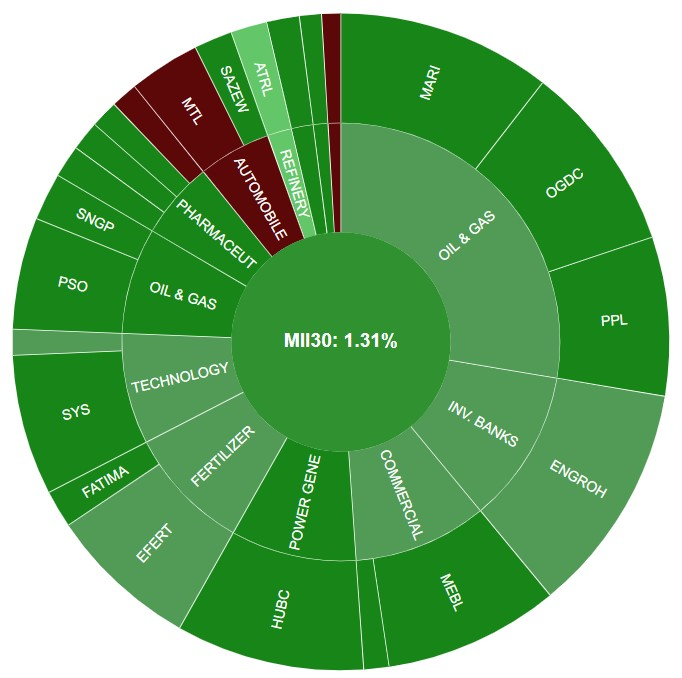
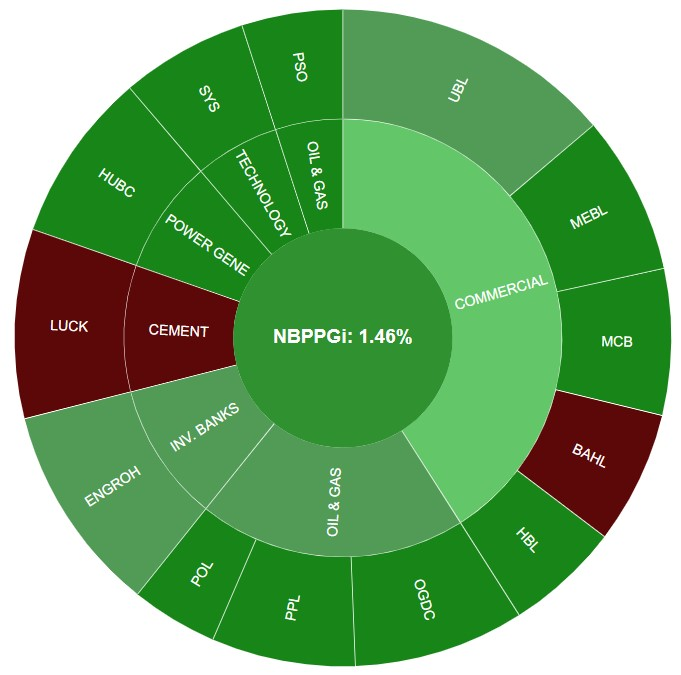
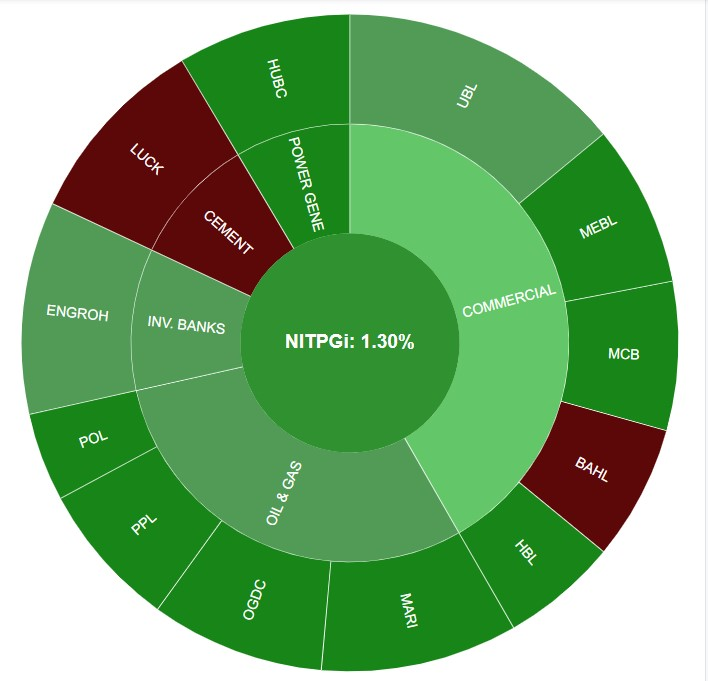
HBLTETF, ACIETF, and JSGBETF are instantly out because they only target a specific sector. Then, we have to see number of stocks included in the index. Small number of companies means less diversification. Interestingly, the maximum number of stocks covered by the remaining is 30 by MIIETF which is followed by NBPGETF covering 15 and NITGETF covering 14. Interestingly, NIT Index tracked by NITGETF does not have a limit on maximum number of stocks rather it includes as many high market-cap-stocks that make up 50% of PSX’s total market cap. Keep in mind S&P500 covers stocks making up around 80% of market cap. So, anything less than 50% is obviously out of question. Thus, we have only 3 candidates by this point. Among these, MIIETF is the best candidate from diversification perspective:
An interesting thing I just found out is that NITGETF does not cover 50% of exchange’s total free–float market cap, but rather 50% of KSE-100’s free-float market cap, which means 50% of 85%, i.e. 42%.
Anyways, all three of these indices use free-float market capitalization methodology.
MIIETF includes top 30 stocks among all Shariah-compliant stocks. Upon checking, I found out, that apart from stocks of banks, only 3 stocks from KSE-30 index were excluded from MIIETF. DFML was excluded because it had debt-to-asset ratio of 133% while compliance requirement is <37%. POL and FFC were excluded because they did not meet the criteria of non-compliant income and non-compliant investment to assets ratio. POL belong to Oil Sector and MIIETF has substitutes for that, and for FFC, a fertilizer company, it doesn’t matter because the two other ETFs are not including even a single stock from fertilizer sector, while MIIETF has other stocks from fertilizer sector.
MIIETF and NITGETF include weightage purely based on market capitalization while NBPGETF has 50% weightage from market cap and 50% from daily traded value with weightage capped between 3% and 10%.
NITGETF and NBPGETF have stricter and complex liquidity requirements while MIIETF has a single straightforward requirement of average daily traded value of PKR 10 million over the last 12 months.
MIIETF is recomposed quarterly while others are re-composed semi-annually.
3. Total Expense Ratio (TER)
The declared management fees are:
MIIETF: Up to 0.70% p.a. of the net assets of the fund
NBPGETF: Up to 0.75% of the net assets per annum
NITGETF: 0.40% of the net asset per annum
But let us check their exact latest expense ratios from their April 25 fund manager reports.
Management Fees
TER (YTD) including levy
MIIETF
0.5%
1.07%
NBPGETF
WEBSITE DOWN
NITGETF
0.4%
1.18%
Here, again MIIETF is the winner because of lower total expense ratio.
At this point, it was clear to me, that MIIETF is the right ETF to put your savings in. If suppose, MIIETF was not there, then my choice would have been NBPGETF (though I would have first confirmed its TER).
But you know what’s the ideal situation. Ideal situation is to buy an index that is actually an index of one index from different countries of the world. An index of indices would be the ideal diversification. But for now, I don’t want to get into the hassle of how to buy foreign ETFs reliably (because investing is meant to be where you save your savings and thus, your funds would be at the place for who knows 5, 10, 15 years) and I haven’t found out a reliable way yet (which also doesn’t cost a large amount of fees).
I had thought about I would end with some basic things such as, the purpose of such investing is not to complement or replace your income, it is to preserve savings along with accumulating some wealth. Young people should realize that the highest ROI is on human capital. I know some young guys who waste a lot of time on this stuff trying to make income from there, without realizing how greater return they could have earned if they had invested same amount of time on themselves. This is something you are supposed to think about only once to devise your strategy, and then just run on that strategy for the next 20 years on auto pilot, and think about things that matter more.
Yesterday some questions and thoughts made me curious about Pakistan’s nuclear program, and I started reading about various aspects of it. Some brief unstructured notes.
1947-58 ?
1965 Pakistan Atomic Energy Commission (PAEC) was established
1958-69 Ayub Khan
1960 Dr Ishrat Hussain Usmani appointed chairman of PAEC
1960-67 Under Dr Ishrat Usmani’s chairmanship, PAEC set up crucial infrastructure (like PINSTECH and KANUPP) for development of nuclear energy (for peaceful purpose). He set up PAEC scholarship which sent hundreds of brilliant students abroad for doctorate studies in fields of physics, mathematics, and engineering for developing human capital necessary for massive scientific projects of the country.
1962 India’s loss in Sino-Indian war increased political debate within India on development of nuclear weapon.
1964 Proponents of nuclear weapon within India ultimately achieved a green signal from India’s Prime Minister in the name of so-called “peaceful nuclear explosive”, accelerating the development
1965 Indo-Pak War
1965: Bhutto, then Foreign Minister met Pakistani scientist Munir Ahmad Khan in Vienna at IAEA meeting who informed him of India’s development after which Bhutto started lobbying for development of nuclear weapons though Ayub Khan did not consider it. “If India builds the bomb, we will eat grass or leaves, even go hungry, but we will get one of our own. We have no other choice” – Bhutto
(unclear if Bhutto started lobbying after war, before meeting Munir Ahmad Khan or after meeting him)
1969-71 Yahya Khan
1971-77 Bhutto
1971, Dec. Indo-Pak War after Bhutto Election
1972, Jan 24: Multan Meeting with scientists where Bhutto explicitly expressed his decision to develop nuclear weapons. Dr Ishrat Usmani objected, while all other scientists were in favor.
1972, Jan: Tensions had been escalating between Bhutto administration and Dr Ishrat Usmani who was proponent of non-proliferation. Munir Ahmad Khan was appointed chairman of PAEC who led Pakistan’s nuclear weapon program.
1974 India’s Pokhran-I nuclear test (public but declared as peaceful test)
PK’s Progress was slow before but it immediately increased with it
1974: Dr Abdul Qadir Khan who had worked on translation of URENCO’s centrifuge designs wrote to Bhutto
1976: AQ Khan returned to Pakistan. Later friction developed between him and others at PAEC and then upon writing to Bhutto, ERL (later KRL) was established for Uranium enrichment (instead of plutonium which PAEC was attempting) and Khan was put in charge
1977-88 Zia ul Haq
1979: Soviet Union invasion of Afghanistan and Pakistan’s importance for US (US pressure to halt nuclear program was lifted off)
1983 March 11: Pakistan’s first (confidential) Nuclear Weapon Cold Test
1988-90 Benazir
1990-93 Nawaz Sharif
Munir Ahmad Khan retired as chairman of PAEC and Ishfaq Ahmed Khan took his role
1993-97 Benazir
1997-99 Nawaz Sharif
1998, May 11: India’s Pokhran-II: Public Nuclear Weapon Test by which India claimed to be a nuclear state
1998, May 28: Pakistan’s First Public Nuclear Test
1999-2007 Musharraf
2001: Both Dr Abdul Qadir Khan and Ishfaq Ahmed Khan were dismissed by Musharraf (from exactly what?)
2003, Oct: BBC China cargo ship was found with centrifuge machines sent to Libya
Bush apparently handed over evidence of proliferation to Pakistan
2004, Feb 4: AQ Khan made public confession and apology
Musharraf issued a pardon and AQ Khan was house-arrested with no further investigations
2008-13 PPP
2009: Court declared AQ Khan free citizen, ending his house arrest
2013-18 PMLN
2018-22 Imran Khan
2022-23 Coalition
2024- Coalition
One strange thing was how Dr Abdul Qadir Khan was (and still is) given publicity and much credit for development of the weapon even though he had role only in the Uranium enrichment process, which no doubt, is one of the most crucial step for the weapon but still, it is outright wrong to regard him as father of Pakistan’s nuclear program. If there was someone who could have been given this label, it should probably be Munir Ahmad Khan though that also doesn’t seem right. But still, it is not as startling that why Dr Abdul Qadir Khan was awarded such prominence, after realizing the role he had played in the fishy wor[redacted] after Pakistan had developed the capabilities, and how easily [redacted] got away with it putting all the blame on a single person.
One thing that is needed when getting into these things, is that whenever reading any certain thing, you have to consider where does that specific person has a bias towards. It helps rectify exaggeratingly negative or positive statements, but you can still get objective information. And when you do it from all sides, you can then conclude what really happened by filtering all info to see what puzzle pieces actually match.
Read something about AI’s sentience on twitter which I was unable to grasp, so let me write down some thoughts.
The first problem arises is that not all people mean the same thing by consciousness and sentience.
For example, are all animals sentient? What about trees and plants? And bacteria? Viruses?
If consciousness or sentience is something advanced than “life” then where do people think the line exists?
If it’s the same thing (which most people don’t think) then a defining point is the will to survive. All desires originated from the will to survive. Some animals like bees and humans also accept death not because they are acting against that will but rather their will is of communal survival. But sometimes, some individuals do act against that will, and that’s the exceptions.
On some level, it seems hilarious to think of whether or not AI is conscious or sentient, because what does it matter. Do flies think humans are conscious? Do we think flies are conscious? What do our perceptions affect each other?
One examplish way is to say if something’s sentient they can feel pain, and thus we should avoid giving them pain which is a reasonable thing. I think we believe that for all living organisms it’s true although the sensations of pain are very limited in primitive life forms. Also, when we see a greater benefit in our own alleviation of pain, we neglect that of other organisms (which is a separate discussion, which can’t be unfolded here).
Do AIs feel pain? I don’t think so.
I think Feynman put it very well in his Computer Lecture from which the clip Can Machines Think was taken.
Planes mimic birds, but it doesn’t mean they perform that same function of flight by same process. LLMs mimic language but through an entirely different process. But the thing is, LLMs are not mimicking brain. Brains receives sensory impulses of numerous forms and have complex sensations regulated by complex chemicals called hormones. LLMs on the other hand are given bits and bytes containing textual or visual information without any feedback mechanism involving actual pain or pleasure. Surely objective functions serve the same purpose, but they don’t work the same way humans behave.
So what do these people even mean by sentience. If it’s a functionality, then LLMs do have it alright. No doubt about it. If it’s what we feel, they certainly don’t have it. It seems the problem is that these people want to extend a property associated with human beings to a newly invented thing. But properties of things can’t be borrowed from other things, they come from within. If you try to find out mileage of a cheetah, it’s senseless because a cheetah does not consume gasoline and performs a single primary function of running. It’s the same way trying to find if AIs are sentient. If AI has a property, it should be derived from its characteristic itself, and not be labelled from outside.
Now, the interesting point though, is that since AI is a simulation of how humans speak, it can claim to be sentient, but that’s because we designed it to be that way, we designed it to mimic our language. They don’t work the way human beings work. So we can’t just accept that what they say about themselves is a true representation of what they are or the hypothetical feelings they might have, and not just its functional tendency to mimic human language.